

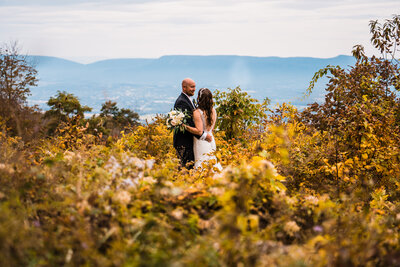




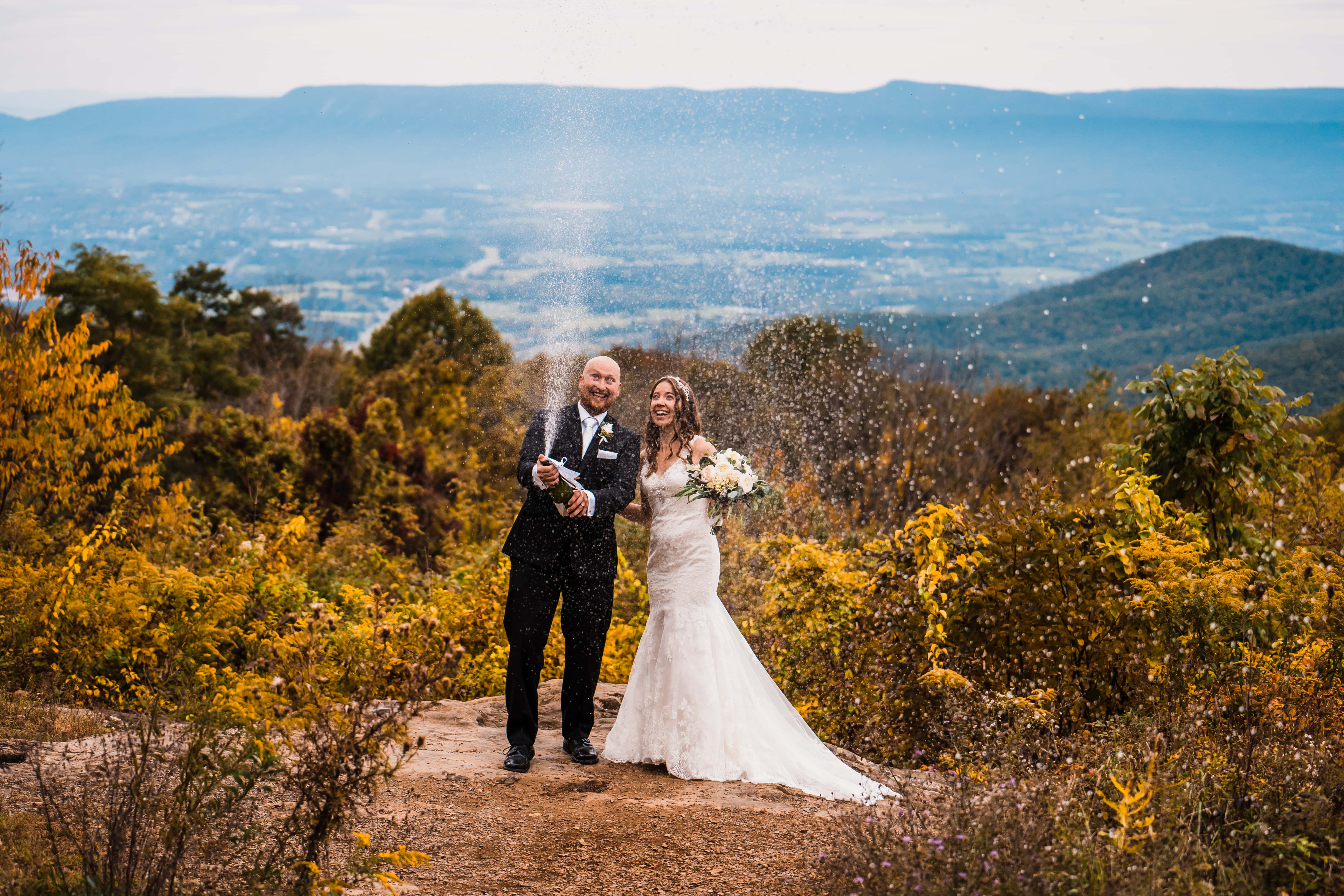
The Blue Ridge Parkway is one of the most beautiful places in the Southeast to get married.
It winds through Virginia and North Carolina, following the ridges of the Blue Ridge Mountains for hundreds of miles. Along the way, you’ll find sweeping overlooks, high-elevation views, quiet forests, mountain towns, waterfalls nearby, and some of the most iconic scenery in the Appalachians.
But planning a Blue Ridge Parkway wedding is not as simple as picking a pretty overlook and showing up.
The Parkway is not a private wedding venue.
It is a scenic public road through the mountains, managed by the National Park Service, with specific approved wedding locations, permit requirements, guest limits, road closures, public access, and major differences from one region to another.
A wedding on the Blue Ridge Parkway can be beautiful.
But it works best when you understand what the Parkway is, and what it is not.
This guide will walk you through how to get married or elope on the Blue Ridge Parkway, what permits are required, which overlooks are approved for ceremonies, how to think through Virginia vs. North Carolina locations, what to do if you want guests, and how nearby Airbnbs, inns, venues, and mountain locations can help create a more complete wedding-day experience.
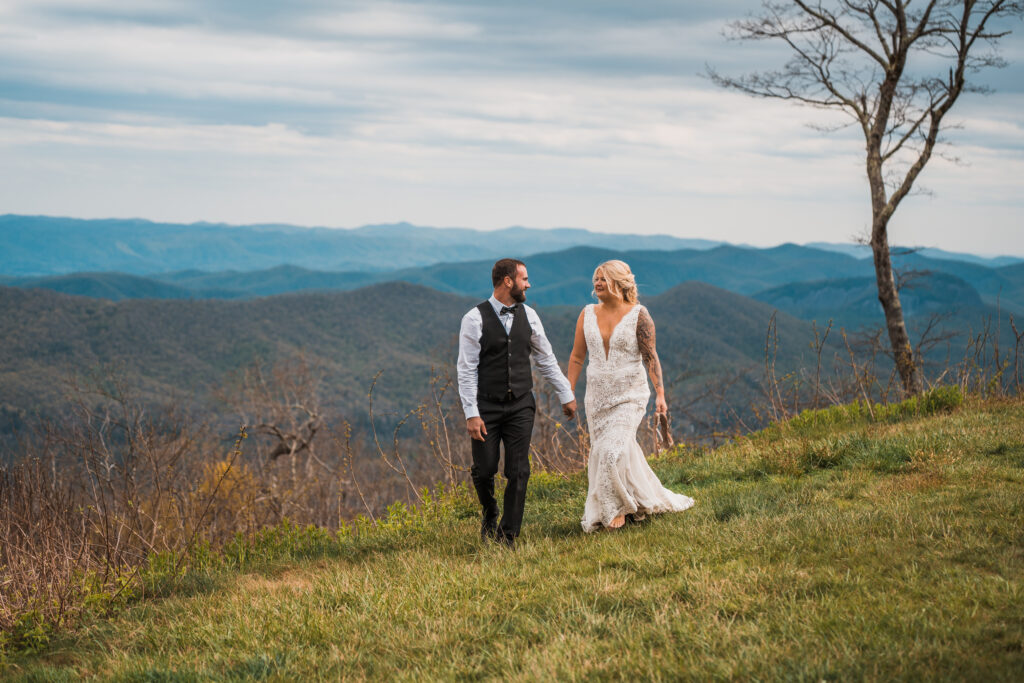
Blue Ridge Parkway Wedding Quick Facts
| Question | Quick Answer |
| Can you get married on the Blue Ridge Parkway? | Yes, at approved locations with a permit |
| Can you elope on the Blue Ridge Parkway? | Yes, but elopements/vow exchanges still need to follow NPS permit rules |
| Is the Parkway a wedding venue? | Not in the traditional sense, It is public land |
| How many people can attend? | Most locations are limited to 25 total people or fewer; some have lower limits |
| How long does a permit cover? | Two hours for ceremony activity |
| Can you have a reception there? | No, the permit does not authorize reception activity |
| Does a permit make the location private? | No, the area remains open to normal visitor use |
| Best fit | Elopements, small weddings, vow renewals, simple ceremonies, couples portraits |
| Biggest planning issues | Permits, road closures, seasonal crowds & traffic, guest count, parking, weather variability, and choosing the right region |
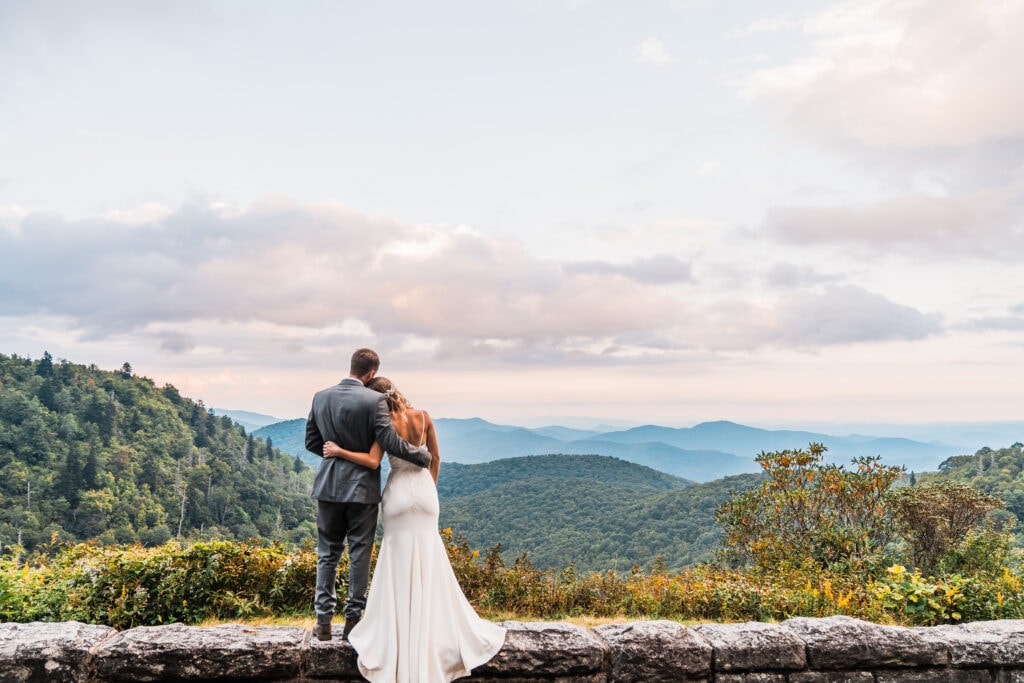
Can You Get Married on the Blue Ridge Parkway?
Yes, you can get married on the Blue Ridge Parkway!
The National Park Service allows wedding, vow exchange, renewal, and elopement ceremonies at approved locations along the Parkway, assuming the location is open and safe for normal visitor use.
But here is the important part:
You cannot simply choose any overlook, trail, waterfall, or viral photo spot and assume it works for a wedding ceremony.
The Parkway has a specific list of approved wedding permit locations. And something else to know: some other popular mountain locations people associate with the Blue Ridge Parkway — like Black Balsam Knob, Linville Gorge, Grandfather Mountain, Mount Mitchell, and Jump Off Rock — are not actually under Blue Ridge Parkway wedding permit jurisdiction.
Those places may still be beautiful options, but just require a different planning path.
This is one of the biggest places couples get confused, and honestly, some online guides do not make the distinction clearly enough.
A location can be near the Parkway without being a Blue Ridge Parkway wedding location.
That matters for permits, rules, access, guest count, and whether your plan is actually allowed.
Blue Ridge Parkway Wedding Permits
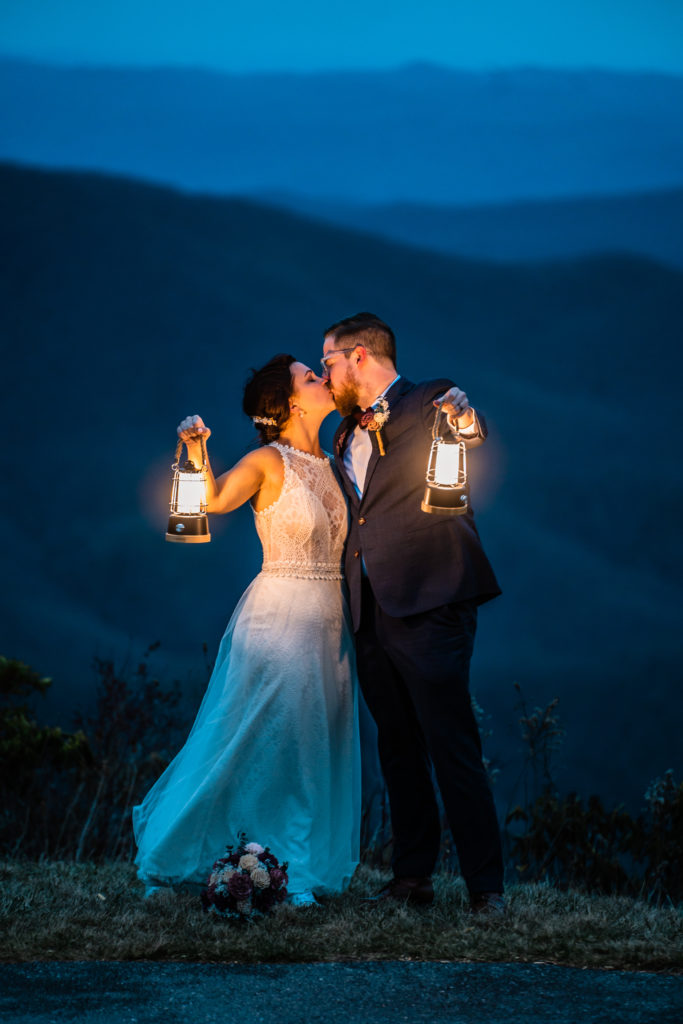
If you want to get married on the Blue Ridge Parkway, you should plan on applying for a special use permit through the National Park Service.
The current permit fee is $150 total, made up of a $75 application fee and a $75 administrative fee. The fee is non-refundable.
A Blue Ridge Parkway wedding permit gives you a two-hour authorization for wedding, elopement, vow exchange, or vow renewal ceremony activity at the approved location, date, and time.
It does not authorize a reception.
It does not provide an officiant, marriage license, photographer, planning services, transportation, or any other wedding service.
It also does not close the overlook or location to the public.
The approved location remains part of public lands and stays open to normal visitor use during your ceremony.
That does not mean you should avoid the Parkway, it just means you need to plan realistically.
A permit gives you approval to use the location for a simple ceremony… it does not turn the Blue Ridge Parkway into a private wedding venue.
A few practical things to know:
- Wedding permits are generally limited to 25 total people or fewer, including the couple, wedding party, officiant, and photographer.
- Some locations have lower guest limits for safety or space reasons.
- If the Parkway road is closed because of public safety concerns, access to the approved location will not be granted.
- There are no rain checks or refunds if weather or closures affect the day.
- A photographer and officiant generally do not need separate permits when they are part of the approved ceremony activity.
This is why we encourage our couples to think beyond just the permit.
The bigger question is:
Does this location, guest count, timing, road access, and backup plan actually support the experience you want to have?
Choosing a beautiful location isn’t enough.
Check out our guide on designing elopements the right way
Blue Ridge Parkway Wedding Locations: Approved Overlooks by Region
The National Park Service lists approved Blue Ridge Parkway wedding locations, but the list itself does not explain how those places feel, where they sit along the Parkway, or how they fit into a real wedding day.
We like to think of the approved locations in three broad regions:
- Virginia Ridge Region
- North Carolina Highlands Region
- Pisgah Region
These regions are helpful because the Blue Ridge Parkway changes dramatically from north to south.
A wedding near Peaks of Otter in Virginia feels very different from a wedding near Boone, Craggy Gardens, or Asheville.
Approved Blue Ridge Parkway Wedding Locations
|
Milepost |
Location |
State |
Region |
Max People |
Notes |
|
MP 10.7 |
Raven’s Roost Overlook |
Virginia |
Ridge Region |
25 |
Rocky overlook, ridge-and-valley views, very busy on weekends |
|
MP 74.7 |
Thunder Ridge Overlook |
Virginia |
Ridge Region |
15 |
Lower capacity, but semi-private setting with valley views |
|
MP 78.4 |
Sunset Field Overlook |
Virginia |
Ridge Region |
25 |
Roadside overlook |
|
MP 85.9 |
Sharp Top Pinnacle |
Virginia |
Ridge Region |
15 |
Lower capacity; more hiking-oriented |
|
MP 139.0 |
Cahas Knob Overlook |
Virginia |
Ridge Region |
25 |
Valley views with Cahas in the distance |
|
MP 168.0 |
The Saddle Overlook |
Virginia |
Ridge Region |
25 |
Southwest Virginia Parkway feel |
|
MP 169.1 |
12 O’clock Knob Overlook |
Virginia |
Ridge Region |
25 |
Ridge/valley scenery |
|
MP 176.2 |
Mabry Mill |
Virginia |
Ridge Region |
25 |
Limited to grassy area near pond |
|
MP 218.6 |
Fox Hunter’s Paradise Overlook |
North Carolina |
Highlands Region |
25 |
Stone outlined platform |
|
MP 241.1 |
Wildcat Rocks Overlook |
North Carolina |
Highlands Region |
25 |
Stone outlined overlook |
|
MP 242.4 |
Alligator Back Overlook |
North Carolina |
Highlands Region |
25 |
Nearby Doughton Park region |
|
MP 264.4 |
The Lump Overlook |
North Carolina |
Highlands Region |
25 |
Quieter part of the Parkway, open grass field (but be mindful of mowing schedules, grass can be high) |
|
MP 294.0 |
Cone Manor |
North Carolina |
Highlands Region |
25 |
Limited to grassy areas in front of Flat Top |
|
MP 305.2 |
Beacon Heights |
North Carolina |
Highlands Region |
25 |
Open granite dome. Limited to right fork trail |
|
MP 320.8 |
Chestoa View Overlook |
North Carolina |
Pisgah Region |
12 |
Rock outlined platform. Lower capacity |
|
MP 350.4 |
Green Knob Overlook |
North Carolina |
Pisgah Region |
25 |
Temporarily unavailable due to Helene damage |
|
MP 361.2 |
Glassmine Falls Overlook |
North Carolina |
Pisgah Region |
25 |
Near Asheville/Craggy region. Narrow platform |
|
MP 367.6 |
Craggy Flats Bald |
North Carolina |
Pisgah Region |
25 |
No wedding activity at the pinnacle or Pinnacle Trail; temporarily unavailable due to Helene damage |
|
MP 407.7 |
Buck Spring Gap |
North Carolina |
Pisgah Region |
25 |
Pisgah/Asheville side |
|
MP 431.0 |
Haywood Jackson Overlook |
North Carolina |
Pisgah Region |
25 |
Southern Parkway region |
|
MP 433.3 |
Roy Taylor Overlook |
North Carolina |
Pisgah Region |
25 |
Southern Parkway region |
This table is a starting point, not a full planning answer.
The right location depends on more than milepost and guest limit.
You also need to think about:
- which region fits your vision
- how many guests are coming
- whether the overlook has enough parking
- what time of year you are planning
- how public the location may feel
- what happens if fog, rain, wind, or road closures affect the day
- where you will stay before and after the ceremony
- where you will go for dinner or a reception afterward
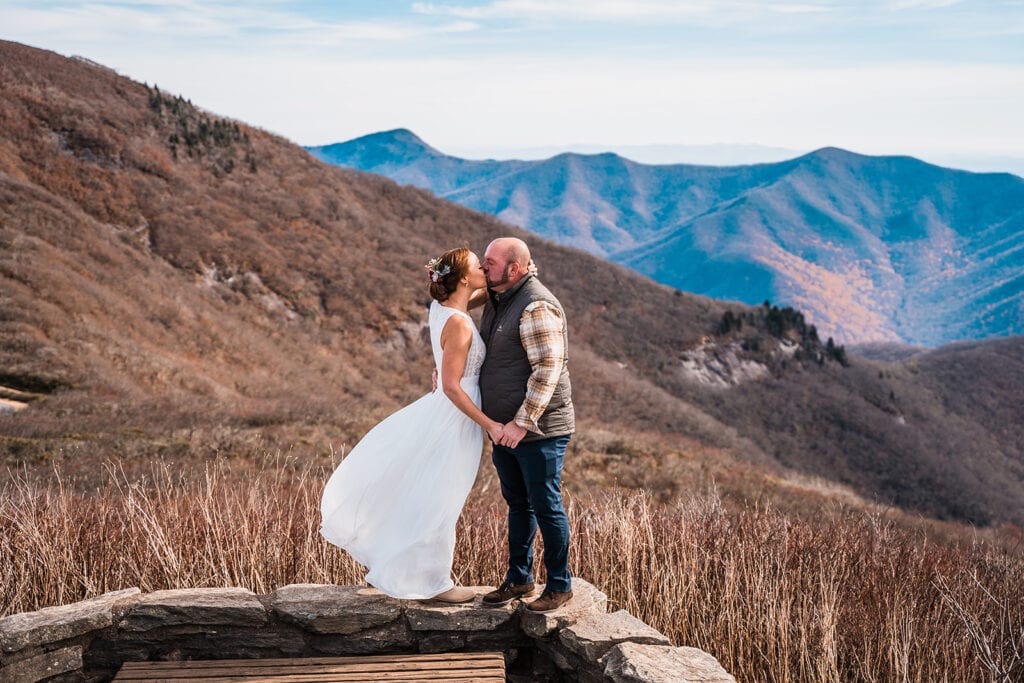
Which Blue Ridge Parkway Region Is Best for Your Wedding or Elopement?
The Parkway is massive… it’s a linear park 469 miles long.
That is one of the most important things to understand.
A Blue Ridge Parkway wedding in Virginia, a High Country elopement near Boone, and an Asheville-area Parkway ceremony are all technically “Blue Ridge Parkway weddings,” but they create very different experiences. We’ve described 3 major regions below of the Parkway – while these aren’t “official” designations, from our experience it helps to imagine the different kinds of experiences and landscapes available across the Parkway.
Not sure where to begin?
A simple planning guide to help you understand what goes into an elopement day, including typical investment ranges, so you can think things through at your own pace.
Virginia Ridge Region
The Virginia section of the Parkway feels like classic ridge-and-valley Appalachia.
This region includes places like Raven’s Roost, Thunder Ridge, Sunset Field, Sharp Top, Cahas Knob, The Saddle, 12 O’clock Knob, and Mabry Mill.
The aesthetic here is generally long ridge views, rolling valleys, a few mountain layers in the distance, and access to places like Peaks of Otter, Roanoke, Floyd, and the broader Virginia Blue Ridge.
This section can be a good fit if you want a quieter Virginia mountain feel, the historic nature of the state, and less of a touristy Asheville/High Country experience… and a wedding day that connects to nearby lodging, unique inns, or mountain towns.
It can also work well for couples comparing the Parkway with Shenandoah National Park or other Virginia mountain locations. (more here in our Shenandoah Elopement Planning Guide)
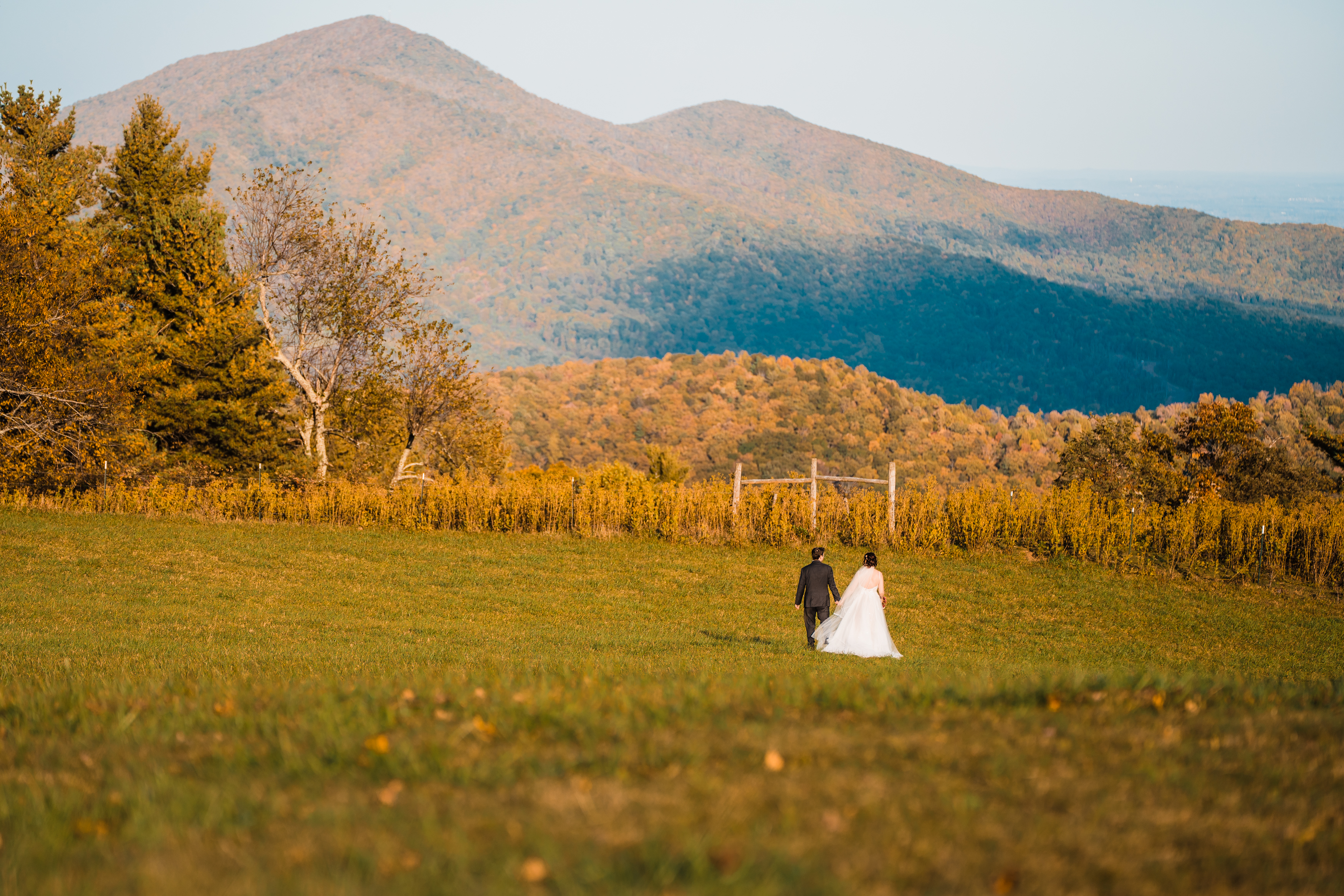
Shenandoah Elopement Guide | Learn More here
Want to know more about Shenandoah National Park for your elopement? Check out our guide!
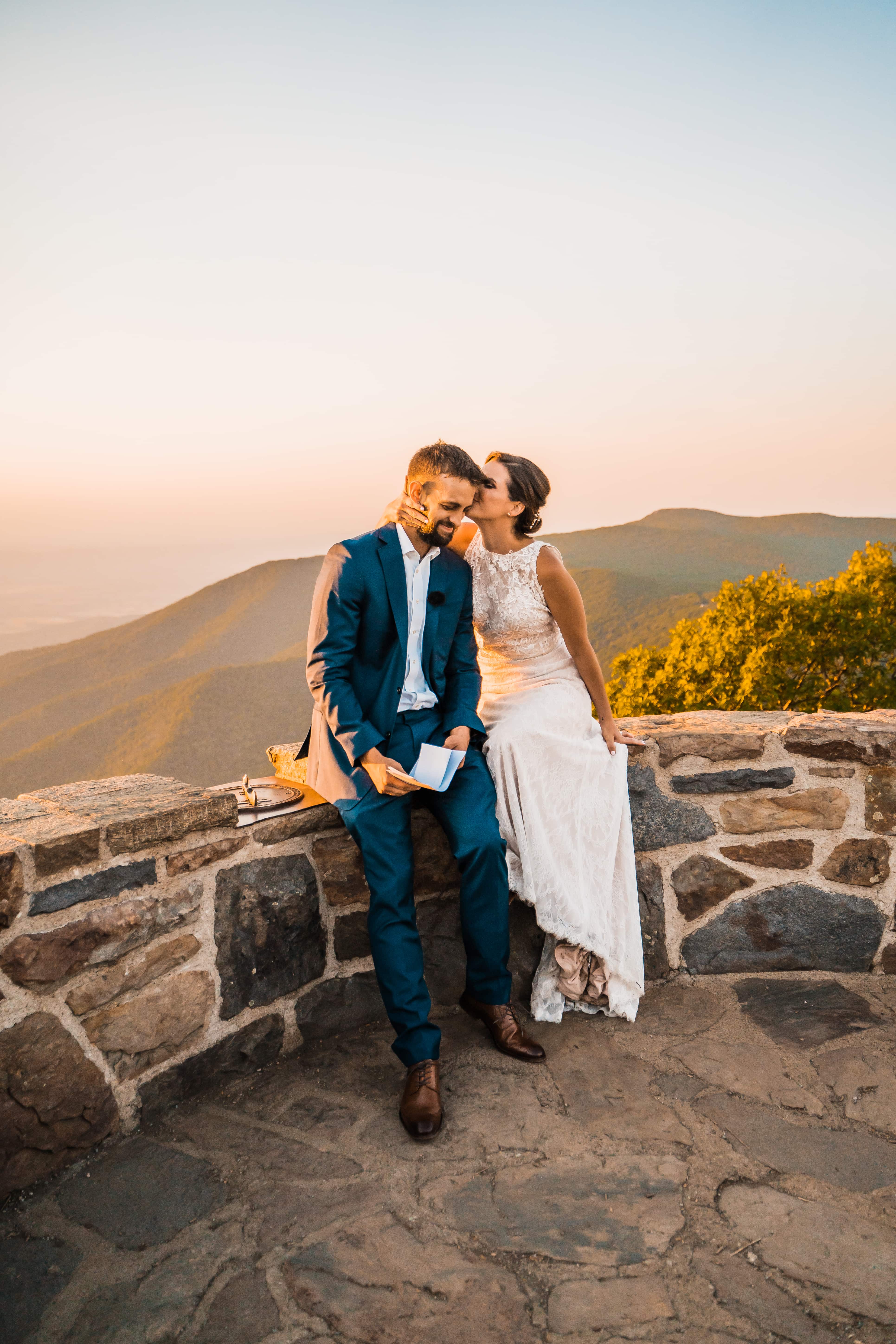
“StoryBright Films helped us from start to finish. They handled the timeline, logistics, location ideas, and vendor recommendations, which took so much stress off our day. We never felt rushed, and everything was photographed exactly how we wanted”
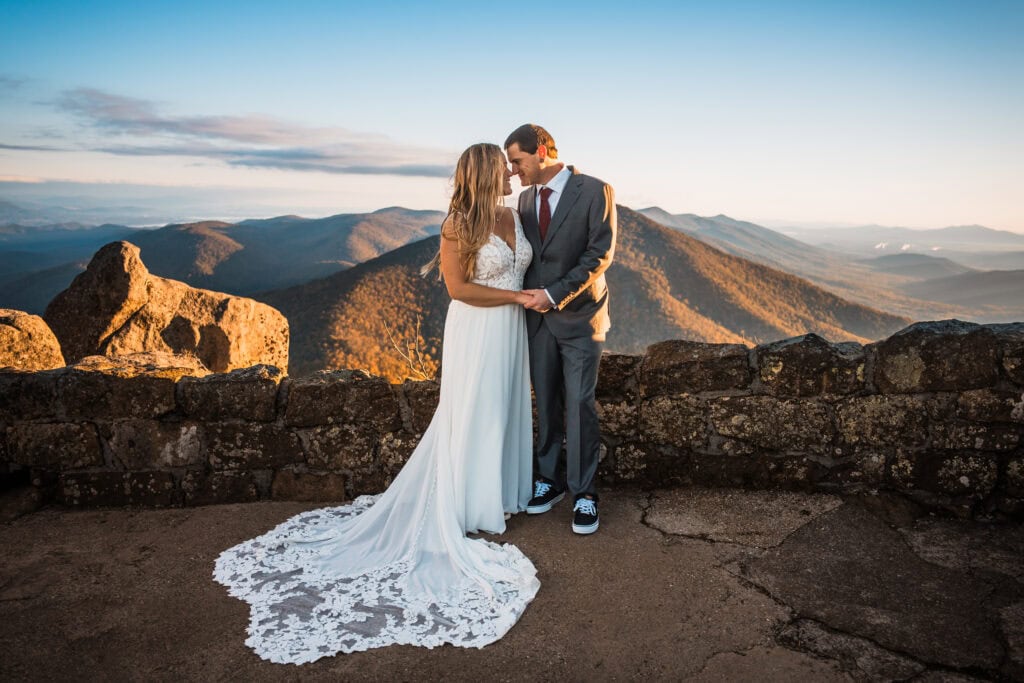
Shelby and Chad’s day is a great example of how we help couples shape a meaningful experience uniquely for them.
You don’t have to carry all of this alone

Mark & Carolyn here! We design thoughtfully planned elopement experiences so couples can stay present, supported, and deeply connected… not stuck managing details.
North Carolina Highlands Region
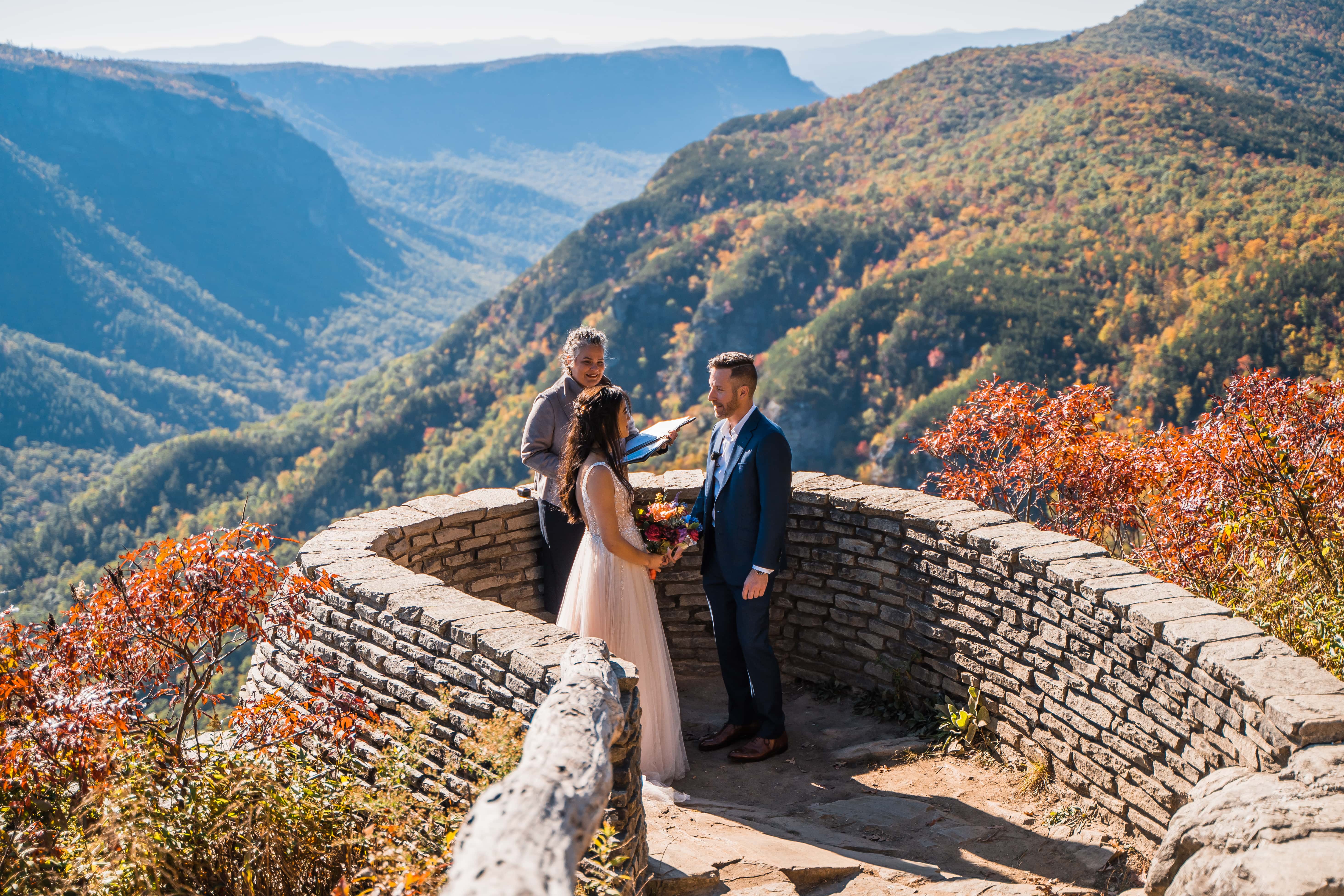
The North Carolina Highlands Region begins around the northern NC Parkway and continues through the Boone, Blowing Rock, and Grandfather Mountain area.
This section includes places like Fox Hunter’s Paradise, Wildcat Rocks, Alligator Back, The Lump, Cone Manor, and Beacon Heights.
This is where the Parkway starts to feel like the classic North Carolina Blue Ridge, with views associated with multiple layers of mountains going off into the distance.
This area puts you near places like:
- Boone
- Blowing Rock
- Banner Elk
- Doughton Park
- Moses Cone
- Price Lake
- Linn Cove Viaduct
- Grandfather Mountain
- Linville
This region can be a strong fit if you want a full mountain weekend, nearby lodging, small towns with lots of things to do, and access to both Parkway views and nearby non-Parkway locations.
If you are drawn to Grandfather Mountain or Linville Gorge, those are nearby but separate from the Parkway permit system. They can still be part of a broader Blue Ridge wedding or elopement experience, but they follow their own rules.
Pisgah Region
The Pisgah Region is the highest-elevation, Asheville/Pisgah side of the Parkway.
This section includes Chestoa View, Green Knob, Glassmine Falls, Craggy Flats Bald, Buck Spring Gap, Haywood Jackson, and Roy Taylor.
This is the region many couples picture when they think of Asheville, Craggy Gardens, dramatic mountain layers, and high-elevation Blue Ridge scenery.
It also gives you access to nearby places like:
- Asheville
- Black Mountain
- Burnsville
- Little Switzerland
- Mount Mitchell
- Craggy Gardens
- Pisgah Inn
- Brevard waterfalls
- Black Balsam Knob
- Sam’s Knob
- More Pisgah National Forest locations
This region can be incredible for options, but it also requires careful planning regarding public lands.
Some of the most popular nearby locations are not actually Parkway wedding permit locations, and some Parkway-approved spots may be temporarily unavailable due to storm damage or road conditions.
If you want the Asheville-area Parkway experience, the Pisgah Region is often the strongest fit, but it is also where backup plans, timing, crowds, fog, and road closures matter a lot.
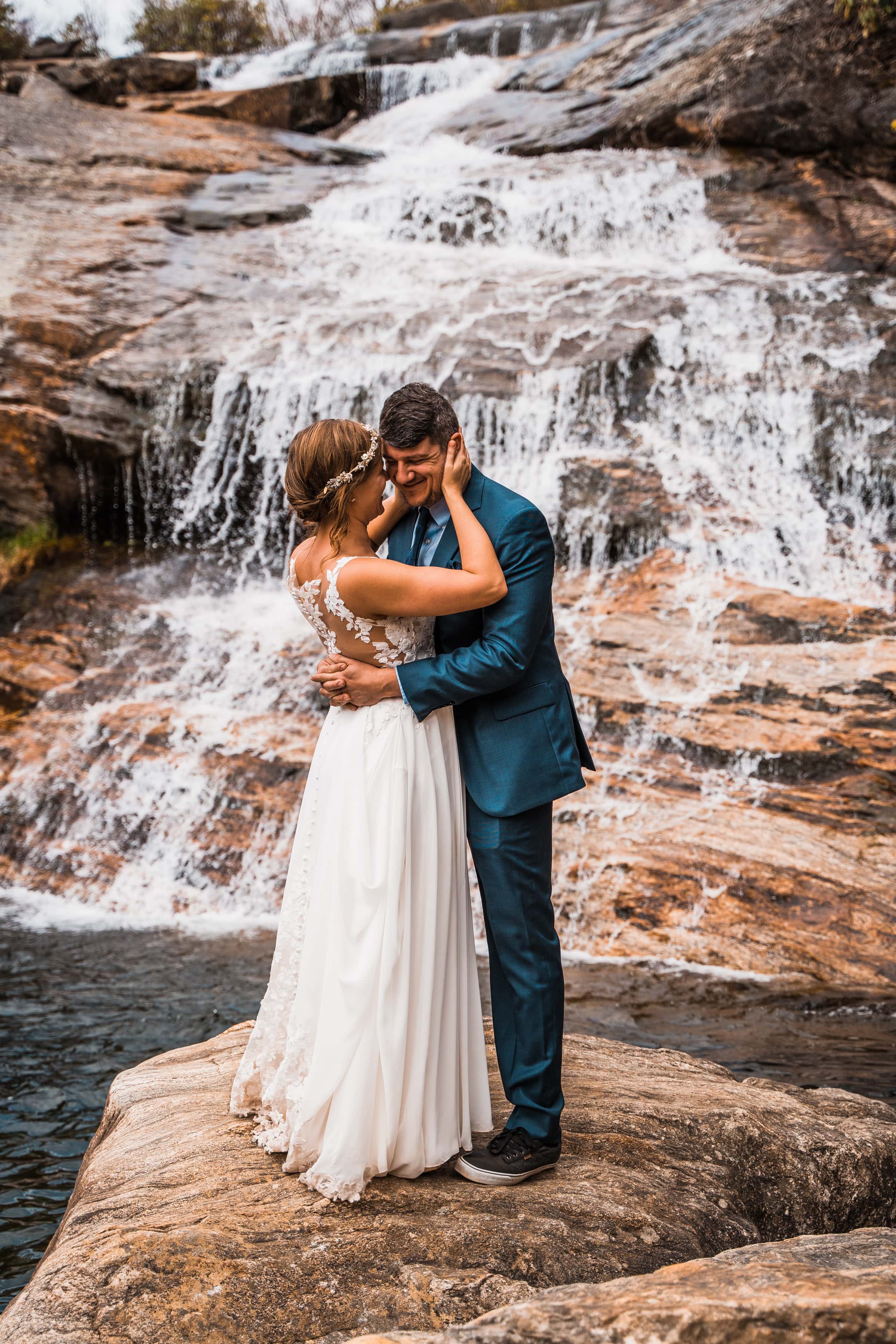
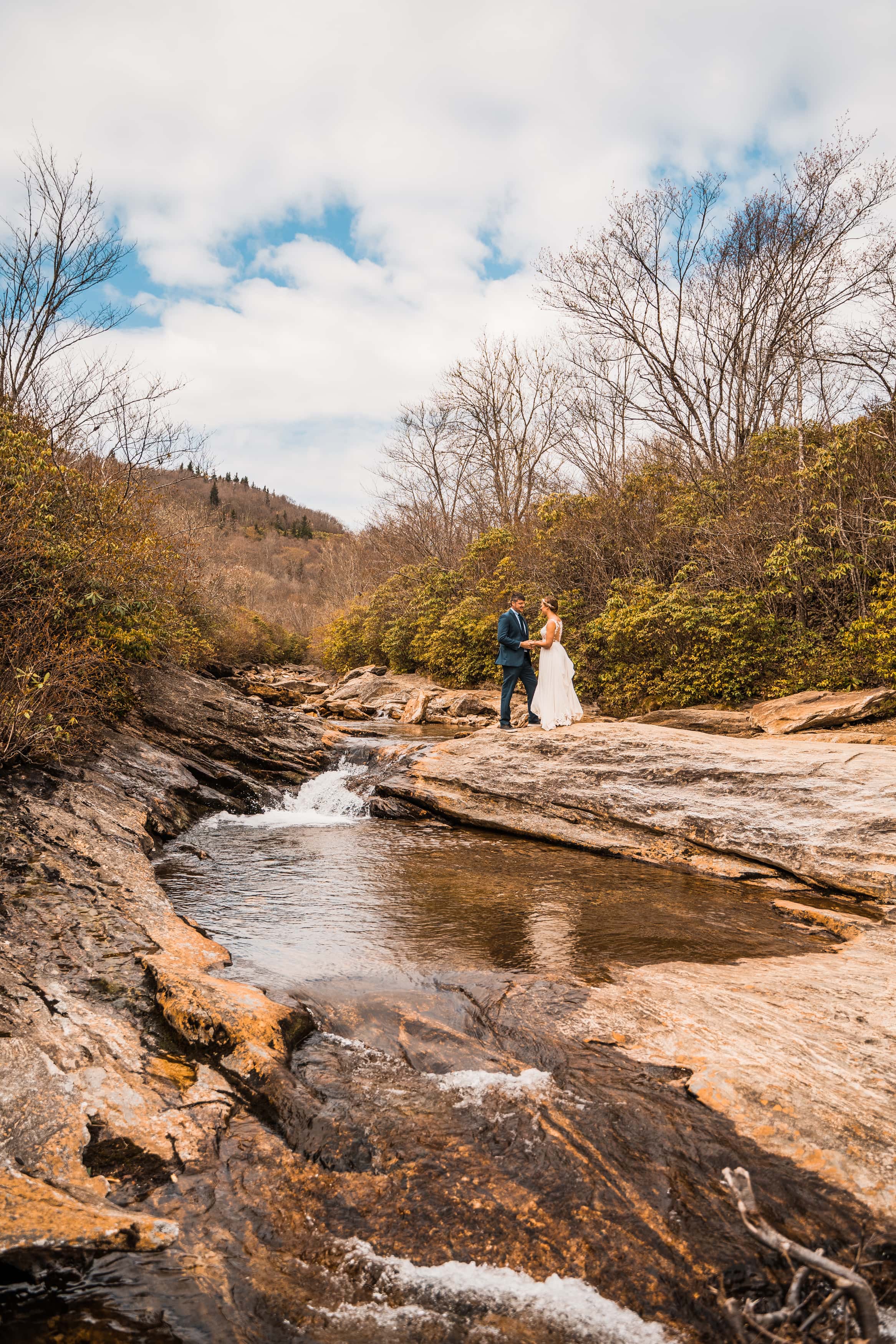
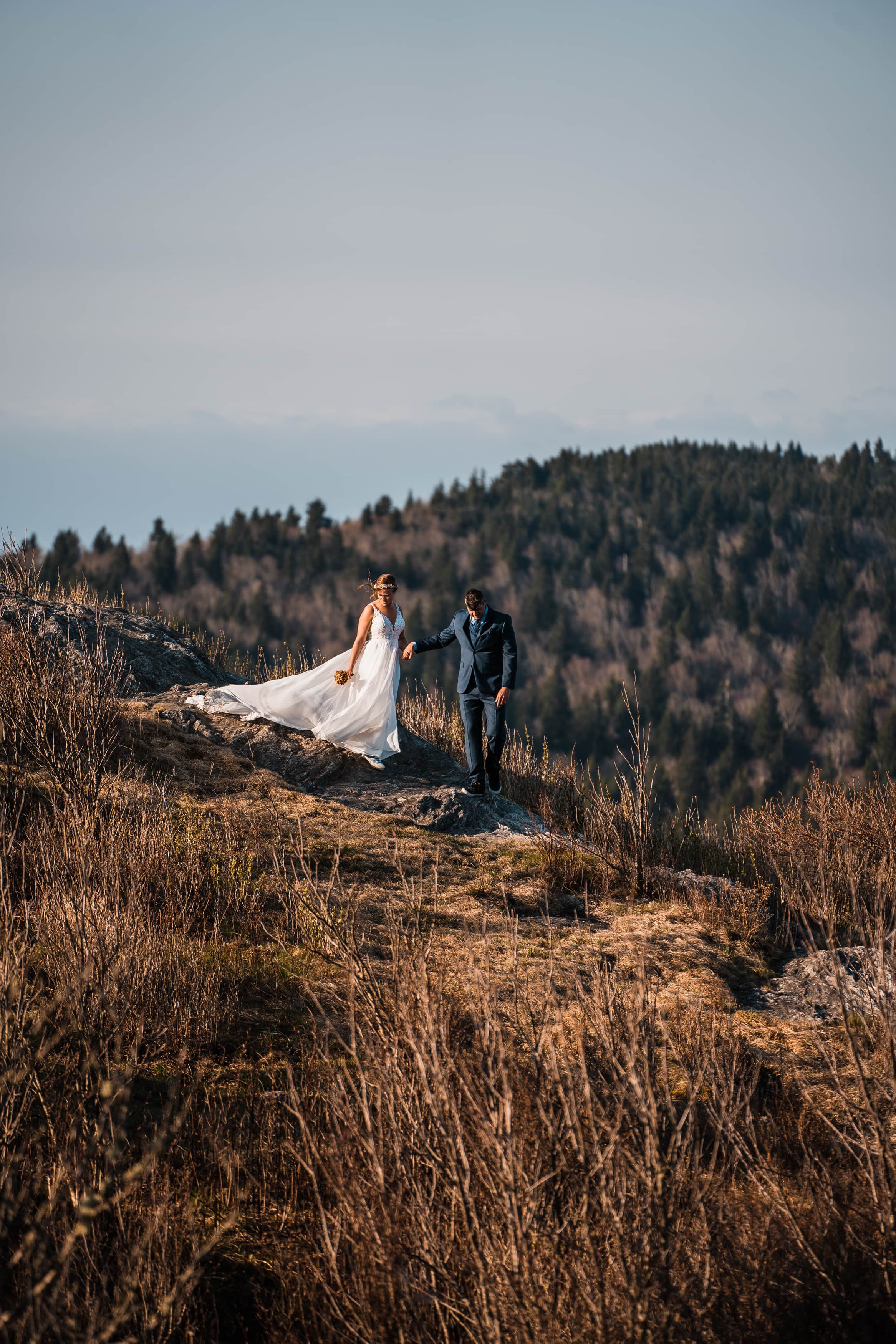
Popular Locations Near the Parkway That Are Not Parkway Permit Locations
Some of the most popular places you might associate with the Blue Ridge Parkway are not actually Blue Ridge Parkway wedding permit locations.
That does not mean they are off-limits, it just means they are not managed through the Parkway wedding permit process.
This matters because each location has its own land manager, rules, permissions, access issues, and guest limitations.
| Location | Jurisdiction / Resource | Why It Matters |
| Linville Gorge | U.S. Forest Service / Pisgah National Forest | Not a Parkway permit location; rugged terrain and access limitations matter |
| Black Balsam Knob | U.S. Forest Service / Pisgah National Forest | Not a Parkway permit location; popular, fragile, and high-impact if planned poorly |
| Sam’s Knob | U.S. Forest Service / Pisgah National Forest | Different rules, trail access, and stewardship concerns |
| Grandfather Mountain | Grandfather Mountain State Park / Grandfather Mountain attraction depending location | Separate rules and permissions |
| Mount Mitchell | Mount Mitchell State Park | Separate state park rules |
| Jump Off Rock | Town of Laurel Park, NC | Municipal location, not Parkway jurisdiction |
These places can be meaningful parts of a Blue Ridge Mountain elopement.
But they should not be casually grouped with “Blue Ridge Parkway wedding locations.”
For example, Black Balsam Knob is one of the most beautiful high-elevation locations in Western North Carolina, but it is not a Blue Ridge Parkway wedding permit site. If you want to understand more about this area, our Black Balsam Knob wedding guide goes deeper into what makes it beautiful and what you need to consider.
Likewise, Linville Gorge is one of the most dramatic landscapes near the northern NC Parkway, but it is a rugged wilderness area, not a simple Parkway overlook. Our Linville Gorge elopement guide is the better resource if that landscape is what you are drawn to.
If you are comparing several nearby mountain locations beyond the Parkway itself, our Pisgah National Forest elopement guide is a helpful next step.
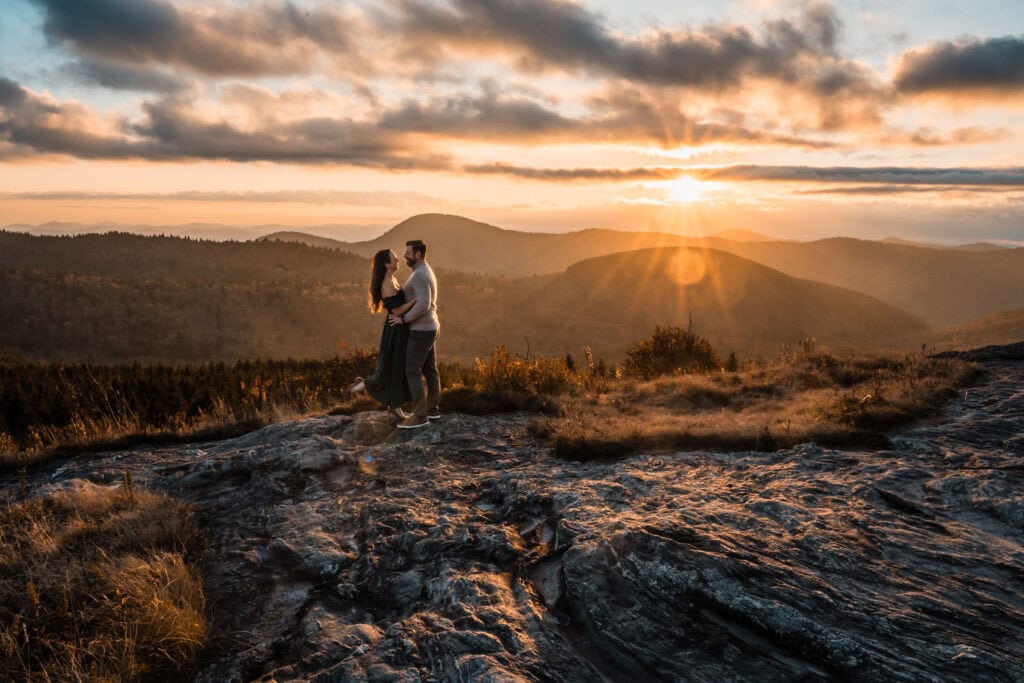
Blue Ridge Parkway Wedding Venues vs. Parkway Overlooks
If you’re searching for Blue Ridge Parkway wedding venues, you might be picturing a private mountain venue with a view.
But that is not what the Parkway is.
The Blue Ridge Parkway gives you public scenic locations for a ceremony, but it does not provide the things a traditional wedding venue usually provides:
- getting-ready space
- reception space
- private access
- bathrooms at every location
- chairs or setup
- catering
- parking control
- weather backup
- staff or coordination
- lodging for guests
If you need those things, you probably need a nearby venue, inn, lodge, Airbnb, or private property to anchor the day.
That does not mean giving up on the Parkway… planning this way may actually make the experience better.
Some of the best Blue Ridge Parkway wedding days are built by pairing the Parkway with another location:
- private cabin ceremony + Parkway portraits
- permitted overlook ceremony + Airbnb reception
- nearby venue or inn + Parkway sunset adventure
- small family ceremony + just-us photos at a second Parkway location
- two-day experience with family time one day and mountain portraits the next
A nearby venue can give you privacy, comfort, and a place for guests to gather.
The Parkway can give you the mountain scenery, movement, and sense of place.
For example, a nearby venue for a wedding like Switzerland Inn in Little Switzerland can make sense if you want lodging, structure, and guest comfort close to the Parkway, while still using the surrounding mountains as part of the experience.
This is the kind of design work we help couples think through: not just “which overlook is prettiest,” but how the full day fits together.
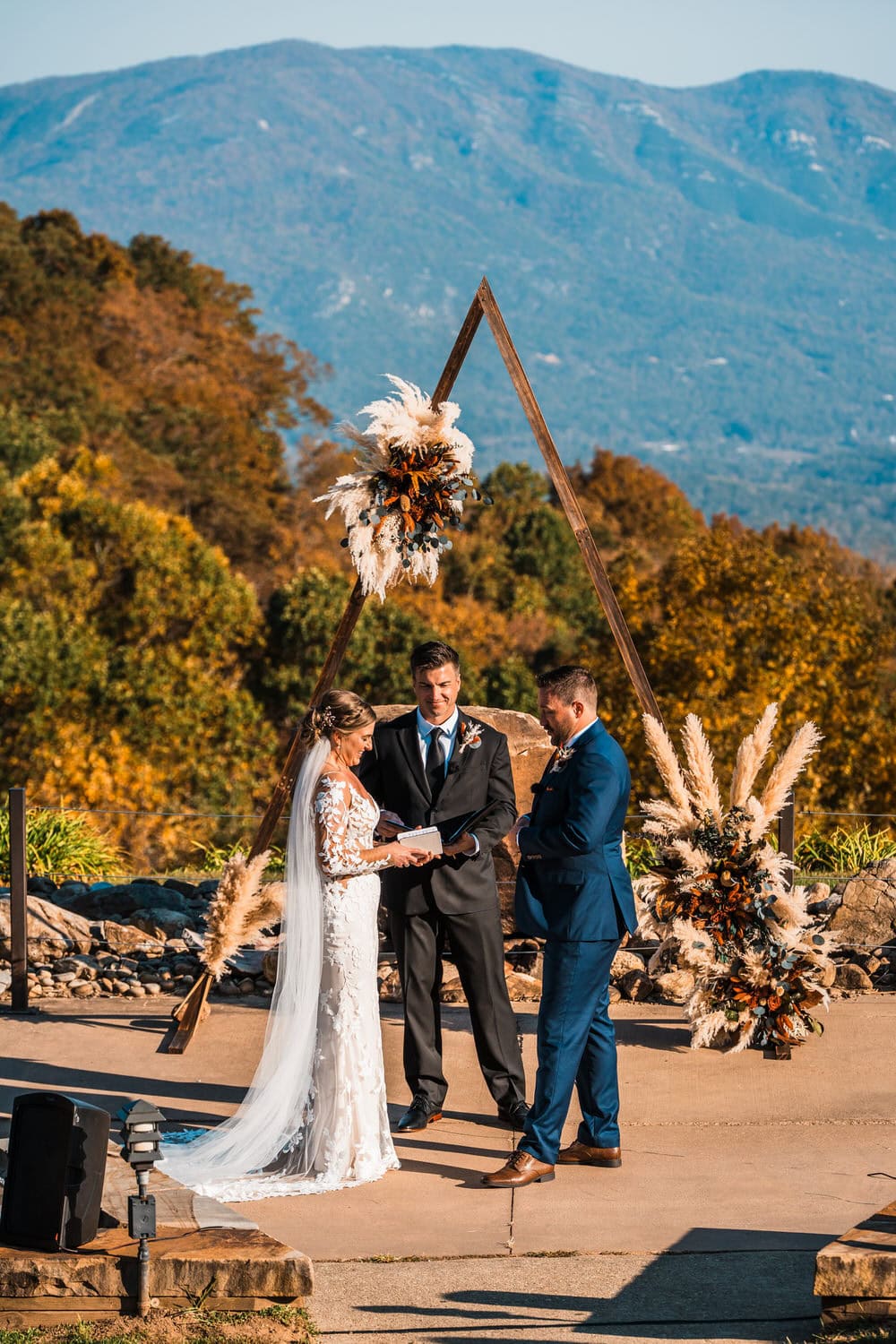
Little Switzerland Wedding
Want to see a real example combining the Parkway and other locations with a nearby location that will accommodate a group?
Can You Elope on the Blue Ridge Parkway?
Yes! And in many ways, elopements are one of the best fits for the Blue Ridge Parkway.
A smaller guest count gives you more flexibility.
You can plan around the best light, choose a quieter time of day, include a short hike or second location, and let the day feel more like an experience than a production.
But a Blue Ridge Parkway elopement still needs to follow the rules.
Your ceremony or vow exchange needs to happens at a Parkway-approved location. You’ll need to plan around the permit process, location availability, road closures, weather, and public access.
A just-us elopement may feel simpler than a larger wedding, but it still needs a thoughtful plan.
That is especially true if you want:
- privacy
- sunrise or sunset timing
- a specific overlook
- backup plans for weather, traffic, and road closures
- photos at more than one location
- a nearby Airbnb or cabin
- a meal or celebration afterward
- a day that feels relaxed instead of rushed
A beautiful overlook is only one piece of the day.
The experience comes from how everything fits together.
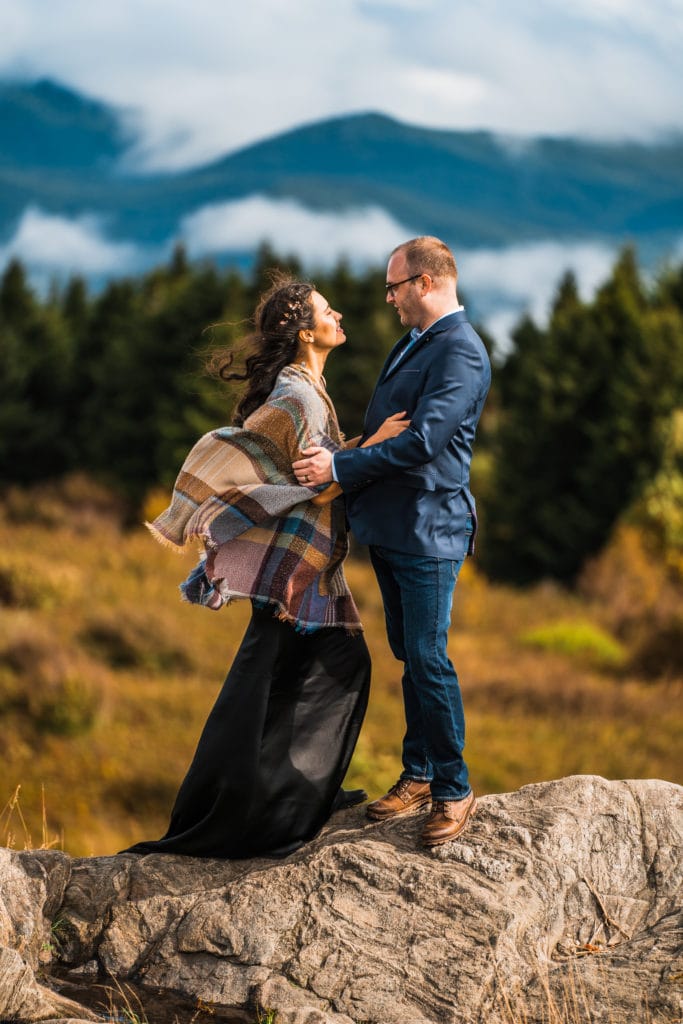
What If You’re Bringing Guests?
The Blue Ridge Parkway can work for small weddings with guests, but guest count changes everything.
Most approved Parkway wedding locations are limited to 25 total people or fewer, and some locations have lower limits.
But the number on the permit is not the only thing that matters.
You also need to think about:
- parking
- bathrooms
- walking distance
- elderly guests or mobility needs
- wind and weather exposure
- how public the location may feel … how close is it to the main road?
- whether the overlook can comfortably hold everyone
- where people go after the ceremony
- how long guests will be standing
- whether the ceremony location feels appropriate for the people you are inviting
For a very small group, an overlook ceremony can be beautiful.
But once you start adding more guests, the Parkway may not be the best place to carry the entire wedding day.
A better plan may be:
- getting ready at a private Airbnb or inn
- ceremony at a permitted overlook
- family photos nearby
- dinner or reception at a rental, venue, or restaurant
- just-us portraits at a second Parkway location
Or:
- ceremony and dinner at a nearby venue
- Parkway portraits afterward
- sunset adventure for just the two of you
If you are still deciding who to invite, our guide on how guest count shapes your elopement is a good place to start.
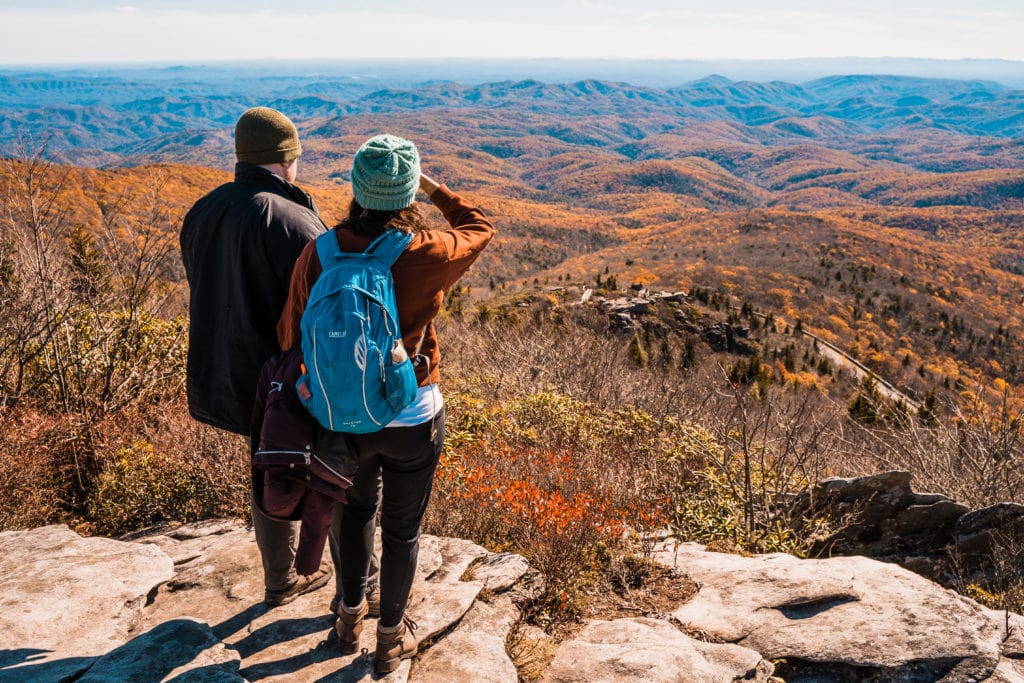
Best Time of Year for a Blue Ridge Parkway Wedding
The Blue Ridge Parkway changes dramatically by season, and elevation plays a huge role.
A spring wedding at lower elevations may feel completely different from a spring wedding near Craggy Gardens, Grandfather Mountain, or Mount Mitchell.
There is no one perfect season for everyone.
The best season depends on what you want the day to feel like.
Spring
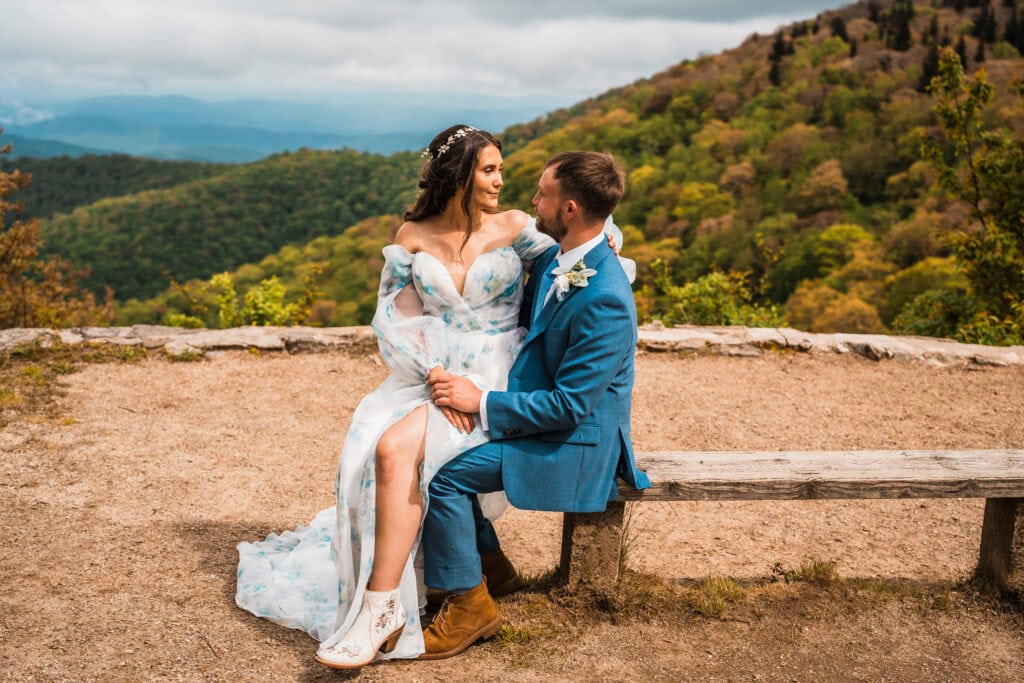
We need to point out first that spring on the Parkway is timed differently than what most of us are accustomed to. If you live in the southeast, many of us are generally accustomed to seeing spring blooms somewhere in the March timeframe. However, because of the elevation, the trees often don’t green up and flowers don’t bloom into late April and even into mid-May depending on the location.
However, while the March-May timeframe might mean dealing with the last hints of winter at elevation, this is still one of our favorite seasons. Being before school is out and generally being a shoulder season, this is a great time to plan your Blue Ridge Parkway wedding to get a little more privacy. Also – being before most of the summer humidity has made its way in – you can often get epic clear views in this season!
Late spring can be beautiful, especially as rhododendrons, mountain laurel, wildflowers and the first buds of greenery begin to appear at different elevations.
Related Post: Why Spring might be the best season to elope in the mountains.
Best for: early wildflowers, waterfalls nearby, less crowds than peak fall & still good “color” on the mountains
Watch out for: fog, spring rains, delayed high-elevation spring, muddy trails, late winter weather
Summer
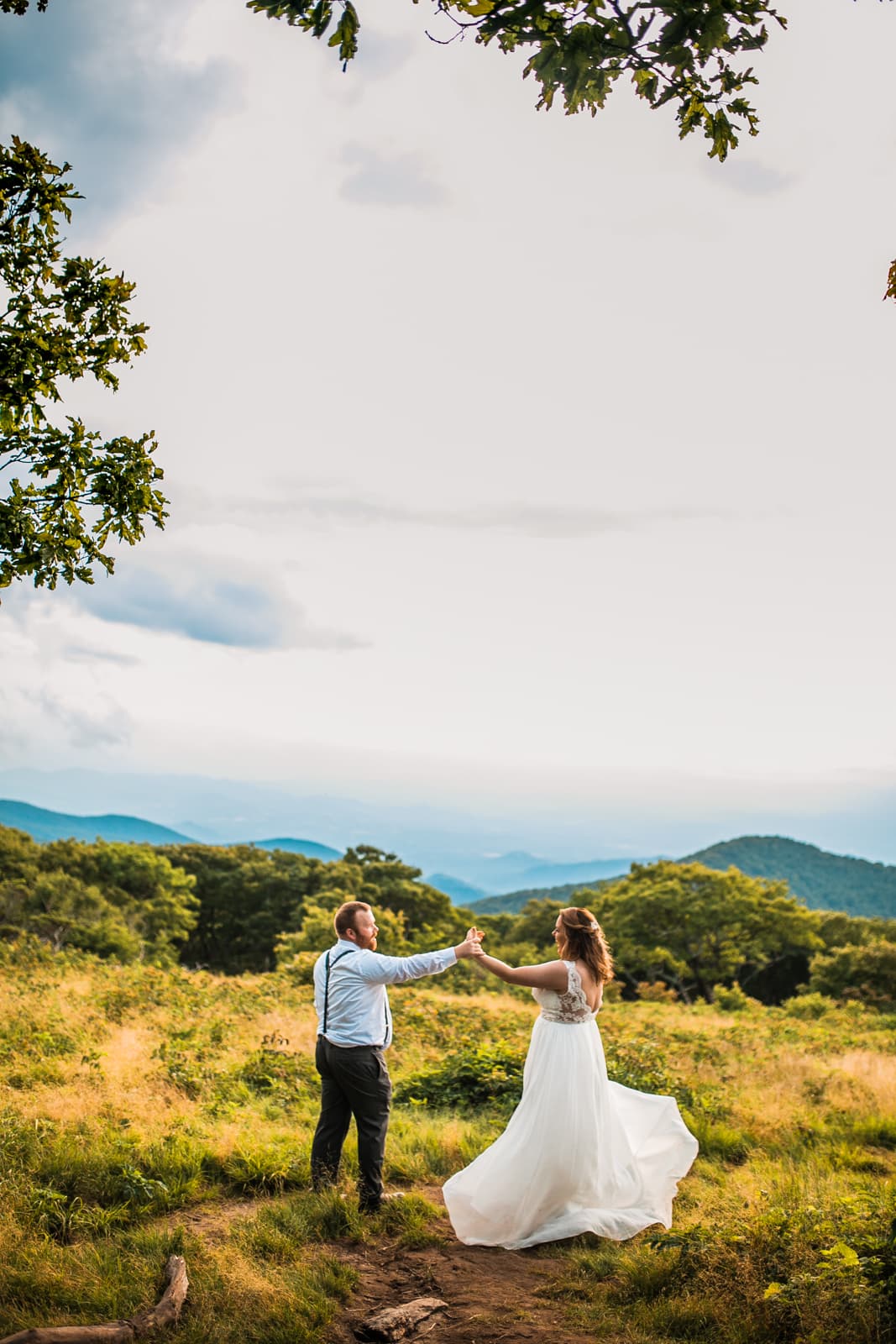
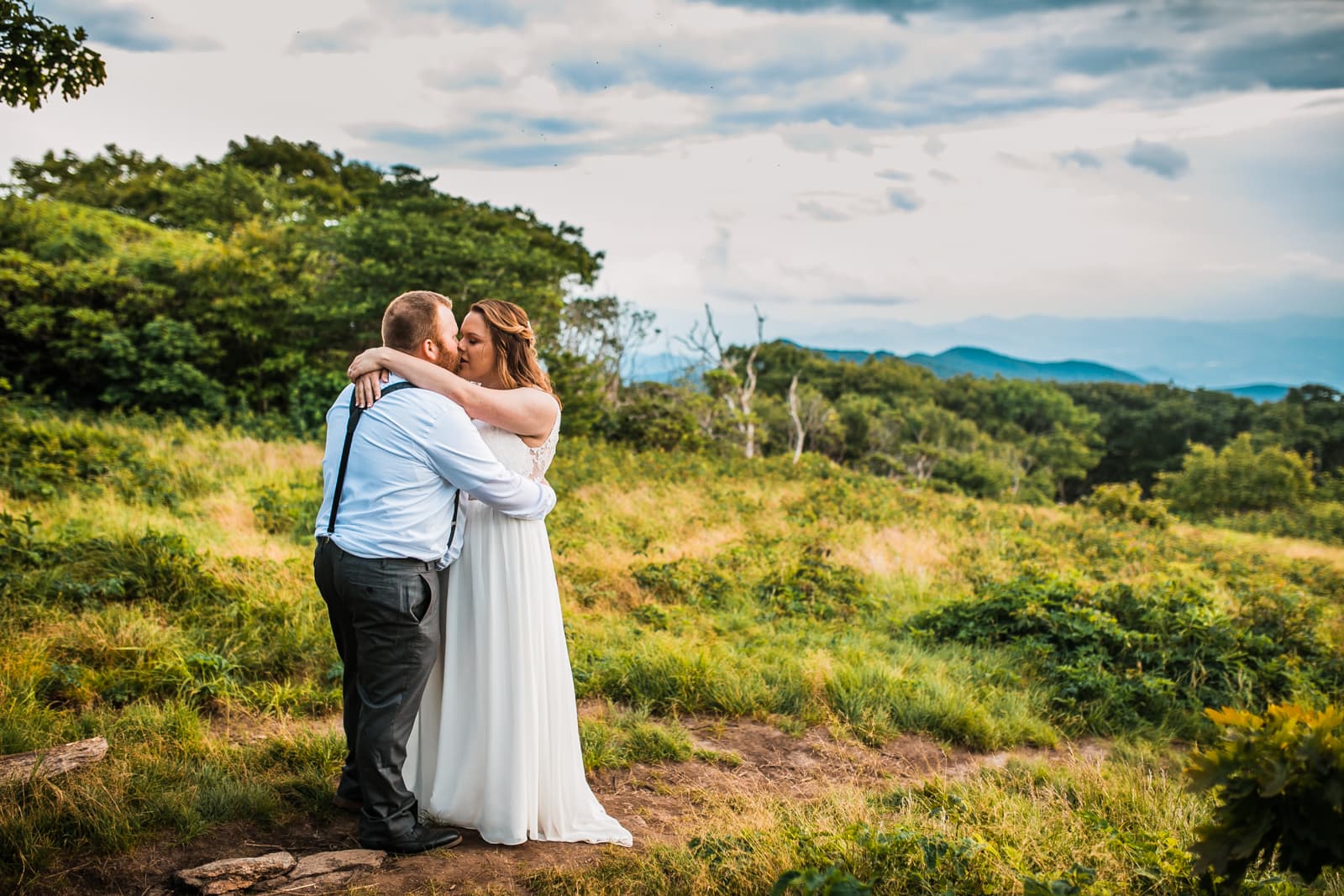
This starts the busy season on the Parkway as many are seeking relief from the summer heat by heading up to elevation. But this is our most favorite season overall because of the flexibility you have on the Parkway! You don’t have to worry about road closures so there are many options before you.
We especially like this season because it gives you the opportunity to enjoy the highest elevations with mild weather and enjoy a waterfall or even a dip in a swimming hole at lower elevations. The mountains hit a peak of full bloom during the summer too!
Another tip: Don’t count out late August. Again – if you’re from the southeast, you might associate August with heat and humidity. But at elevation it is a different story, and it’s also a nice lull as school gets back into session and before the leaf season of the fall.
Best for: lush mountain views, long days, cooler high-elevation temperatures, relaxed timelines
Watch out for: afternoon storms, humidity at lower elevations, tourist traffic on weekends, bugs
Fall
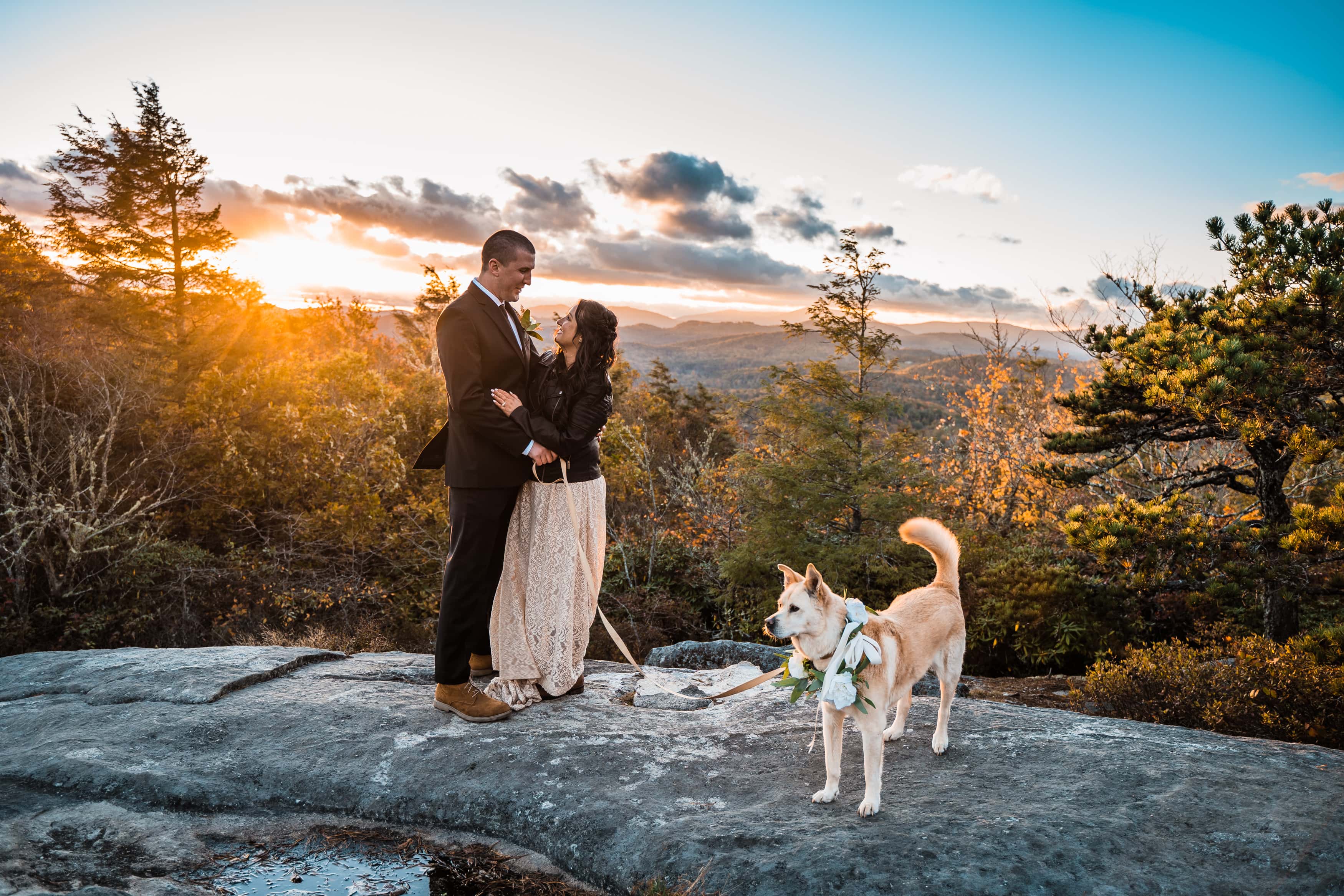
We’ll just say up front; it’s important to manage expectations when it comes to getting married on the Parkway in the fall. While the Parkway recently started allowing wedding permits in October, it’s SUPER important to have a local’s understanding about which times of the day or days of the week are feasible. There is just so much traffic in peak leaf season, it’s usually not advisable to try and plan a wedding ceremony at an overlook on a Saturday afternoon.
Our advice for this season:
- Look at either September or November to avoid the crush of tourists at popular spots
- Consider a time early or late in the day if you need a weekend
- Have your wedding on a weekday if possible
- Book a year in advance!
You might be able to get a permit with relatively short notice, but all the other things you’ll need (lodging, vendors etc) will be booked far in advance. Our advice – plan for fall one year ahead of time!
Best for: fall color, crisp air, mountain lodging with outdoor fire pits, dramatic views
Watch out for: crowds, traffic, limited lodging, peak-season pricing, packed overlooks & trails
Winter
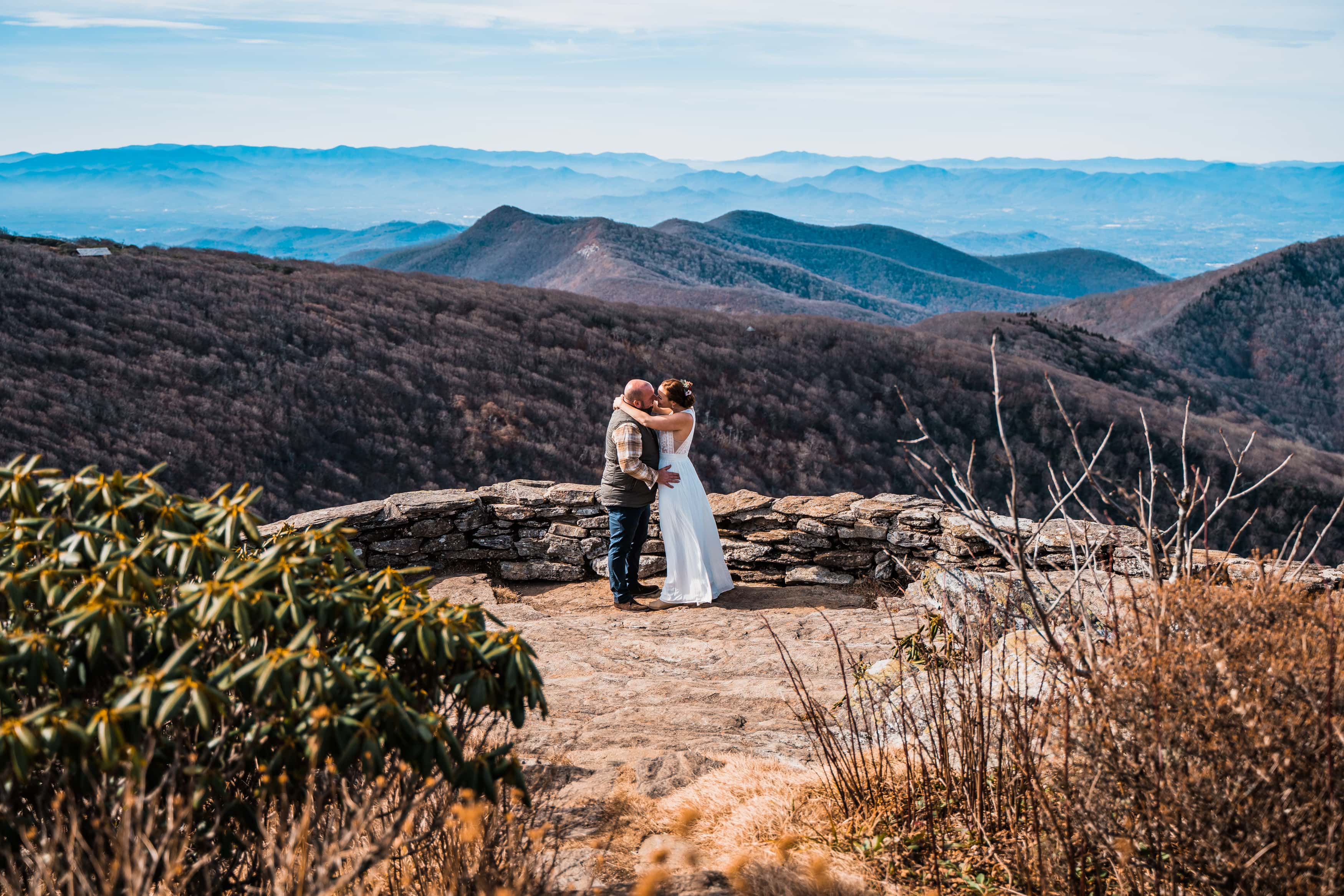
The best thing about the off-season of winter (which we would define as roughly from late November until mid-March on the Parkway) is that you have the chance to have many locations all to yourself. Yes, you run the risk of poor weather and road closures (which is why it’s important to have backup plans) but the reward is having all the views without the crowds. If you time it just right, you might even have the chance to have your wedding photos in the snow. How cool would that be?
Best for: quiet mountain views, privacy, chance of snow
Watch out for: road closures, cold, shorter daylight, bare landscapes, limited services
Blue Ridge Parkway Weather, Road Closures, and Backup Plans
Weather is one of the biggest reasons a Blue Ridge Parkway wedding needs a real plan.
The Parkway follows high ridges, which means conditions can change quickly.
You may deal with:
- fog
- heavy cloud cover
- wind
- rain
- storms
- ice
- road closures
- construction
- storm damage
- lower visibility
- colder temperatures than expected
A permit does not guarantee access if the Parkway road is closed.
It also does not provide a backup location, tent, rain plan, or refund.
This is why we always think through backup options before the wedding day.
A backup plan might mean:
- a nearby Airbnb ceremony
- a private venue or inn
- a covered porch
- a lower-elevation location
- a flexible second portrait location
- moving the timing earlier or later
- building extra travel time into the day
The goal is not to be afraid of weather.
The goal is to design a day that can still feel meaningful if the mountains do mountain things.
Blue Ridge Parkway Wedding | Climate & Weather
Intertwined with the choice of region and seasons, the climate and weather are things to think about when you’re planning a Blue Ridge Parkway Wedding or Elopement.
Lower Elevations (< 3000 ft ASL)
This generally covers the Plateau region and portions of the Highlands region before reaching the area around Boone.
Here, you’ll find the climate and weather similar to the surrounding foothills. Summer may feel the same, if only slightly milder. In contrast these elevations tend to avoid road closures when winter weather comes through and closes the road in other locations.
Mid Elevations (~3000-4500ft ASL)
The Highlands region is where you’ll find consistent elevations in this range, and it’s also where you’ll notice a climate difference to the valleys below. Summers have a milder feel and nights are cooler, and that trend continues into the fall. Winter may leave these elevations with a dusting of snow when only rain hits the valleys.
Still, the weather tends to follow the patterns of the lower elevations. For example, expect afternoon showers and thunderstorms in the summer just like the lower elevations.
One can think of the mid elevations as having the same seasons, if not offset about a month from the foothills. Spring & winter start about a month later.
High Elevation (~4500-6000ft ASL)
This describes the Pisgah region almost in its entirety and also exhibits the most drastic climate and weather differences vs. the valleys below.
For example, when there is high humidity & a mostly cloudy day in the foothills – with spots of sun here and there – you can often expect elevations of 5500ft and above to be fogged in or even scattered showers when there is no forecast for that in the area.
Summer thunderstorms that might be scattered and weak in the lower elevations tend to be magnified and sneak up on you at the higher elevations. Especially in the summer, exercise caution hiking in the afternoon as this is when storms pop up!
While locations at these elevations typically have the best views on the Parkway, they also are subject to closures the most due to ice on the road. Generally, we don’t recommend planning a Blue Ridge Parkway wedding at high elevations in the months of December, January or February (without a solid backup plan, for example having a reception venue double as your ceremony venue just in case).
There are also pockets of microclimate. For example, the section of the Parkway near Graveyard fields, Devil’s Courthouse and Black Balsam Knob is one of the wettest spots in all of North Carolina. This is part of the reason there are so many waterfalls, because they are being fed by this watershed!
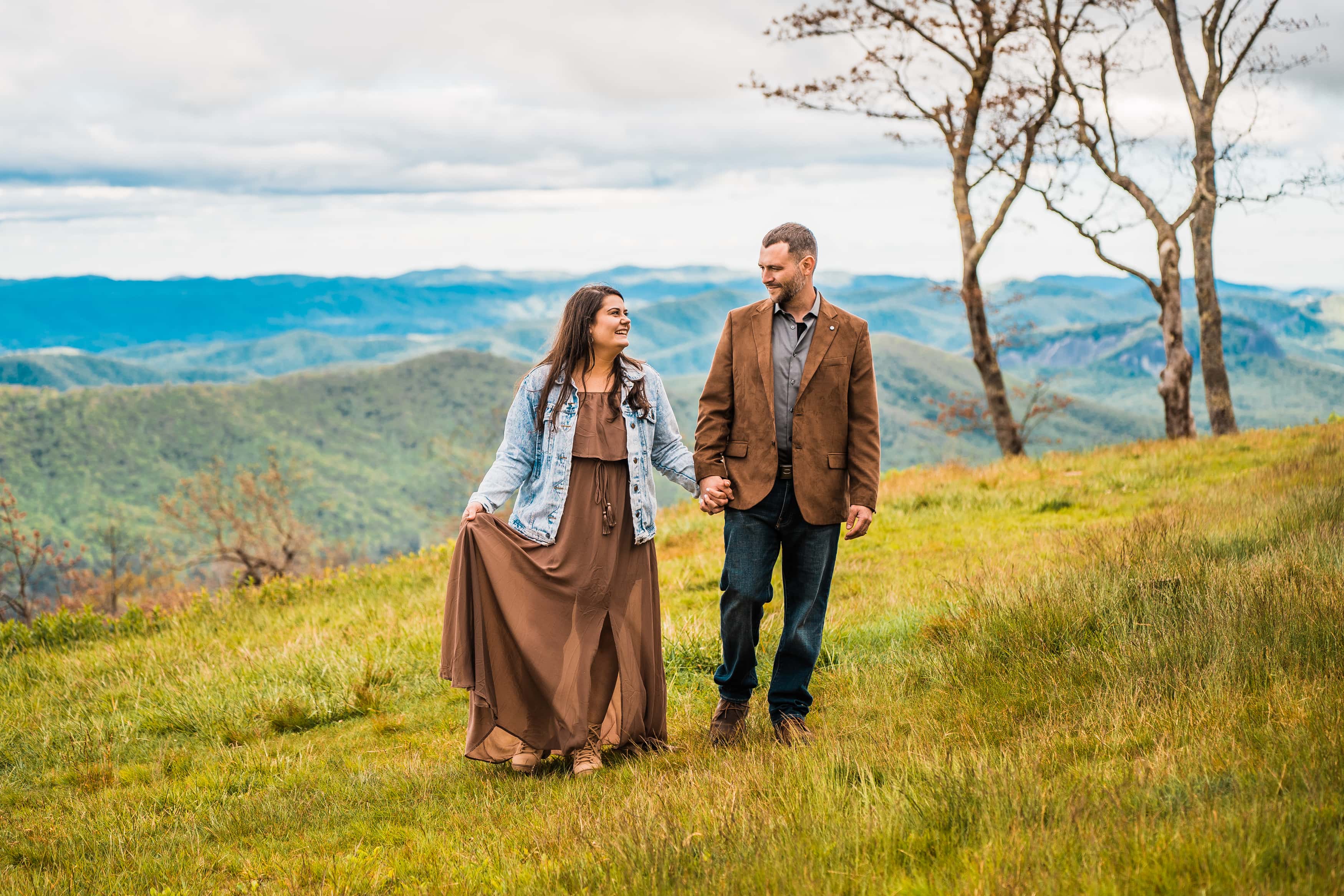
Where to Stay for a Blue Ridge Parkway Wedding
Where you stay should be considered as you are deciding which section of the Parkway you are using – not as an afterthought.
This is important because the Parkway is long, winding, and is slow driving.
A rental may look close on a map but still be far from the overlook, trail, venue, or dinner location you actually need.
Virginia Ridge Region
For Virginia Parkway locations, look at areas such as:
- Charlottesville
- Roanoke
- Bedford / Peaks of Otter area
- Floyd
This region can work well if you want a quieter Virginia mountain feel or if your day is built around ridge-and-valley scenery.
North Carolina Highlands Region
For the High Country section, consider:
- Boone
- Blowing Rock
- Banner Elk
- Linville
- Little Switzerland
This region is strong if you want a full weekend mountain feel with lodging, restaurants, small towns, and access to Grandfather Mountain, Linville Gorge, Moses Cone, and other nearby landscapes.
Pisgah Region
For the Asheville/Pisgah section, consider:
- Asheville
- Black Mountain
- Marion
- Brevard
- Waynesville or Canton depending on your location
- Bryson City
This region is strong if you want access to Asheville amenities, waterfalls, high-elevation views, and Pisgah National Forest.
A private Airbnb or cabin can be especially helpful if you are bringing guests, need a getting-ready space, want a dinner or small reception, or need a weather backup. Check out our Curated Guide to Airbnb Wedding Venues in NC, which is a helpful next step if you are considering a private rental as part of your Parkway wedding day.
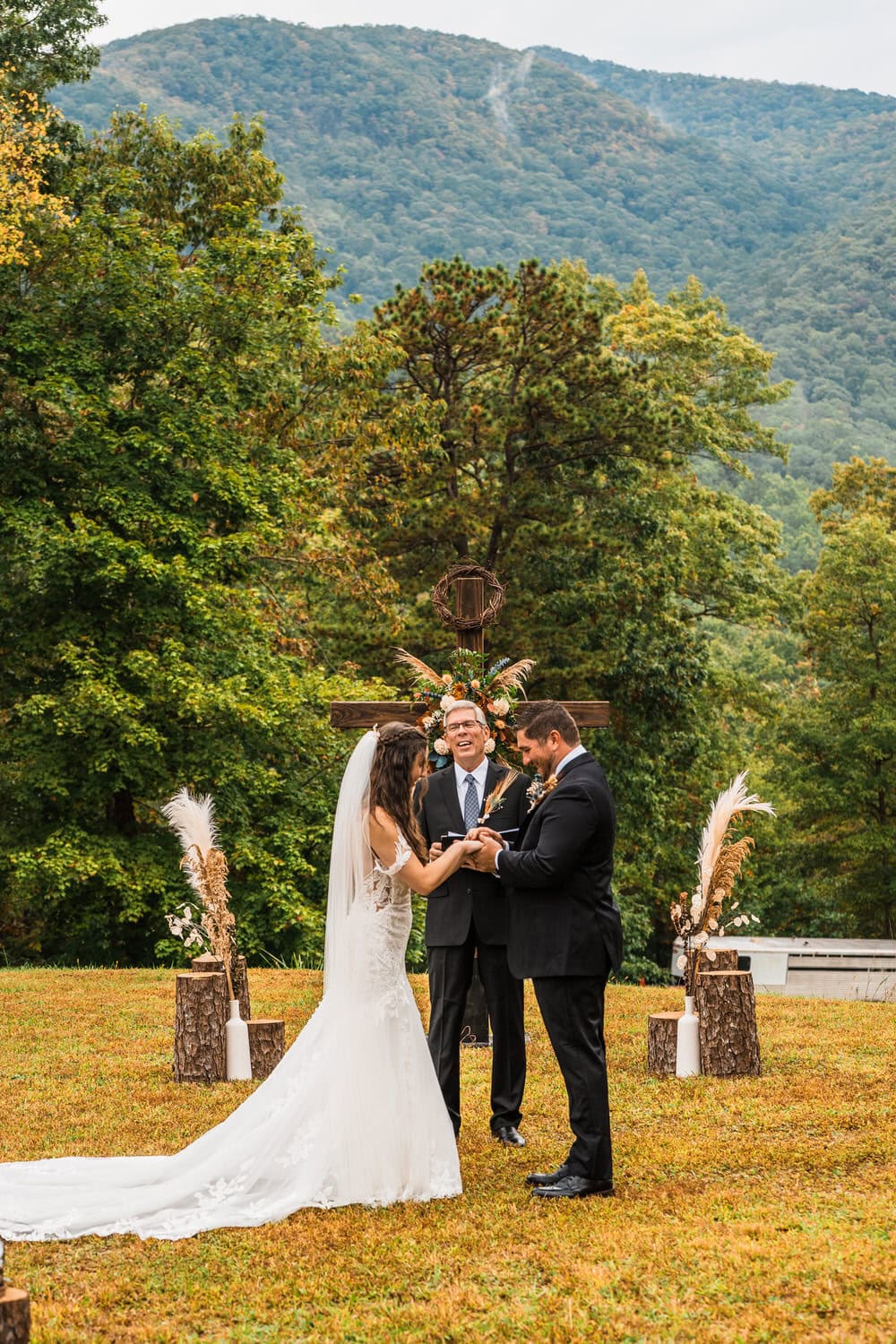
Airbnb Wedding & Elopement Venues NC | Learn More here
Check out our complete guide to finding the right Airbnb in North Carolina for your elopement!
Example Blue Ridge Parkway Wedding and Elopement Day Designs
There is no single correct way to plan a Blue Ridge Parkway wedding. Every couple is different, so every day should be different.
But for you to see some inspiration, here are a few real examples the day can come together from our experience!
Just-Us Blue Ridge Parkway Elopement
Imagine easing into your day in the morning, sharing coffee and getting ready at a cabin near the Parkway.
Then you head out early for a quiet ceremony at an approved overlook, followed by a short hike to another location for a picnic, celebrating in your own way as you enjoy sunset together.
The day stays simple, flexible, and focused on the two of you.
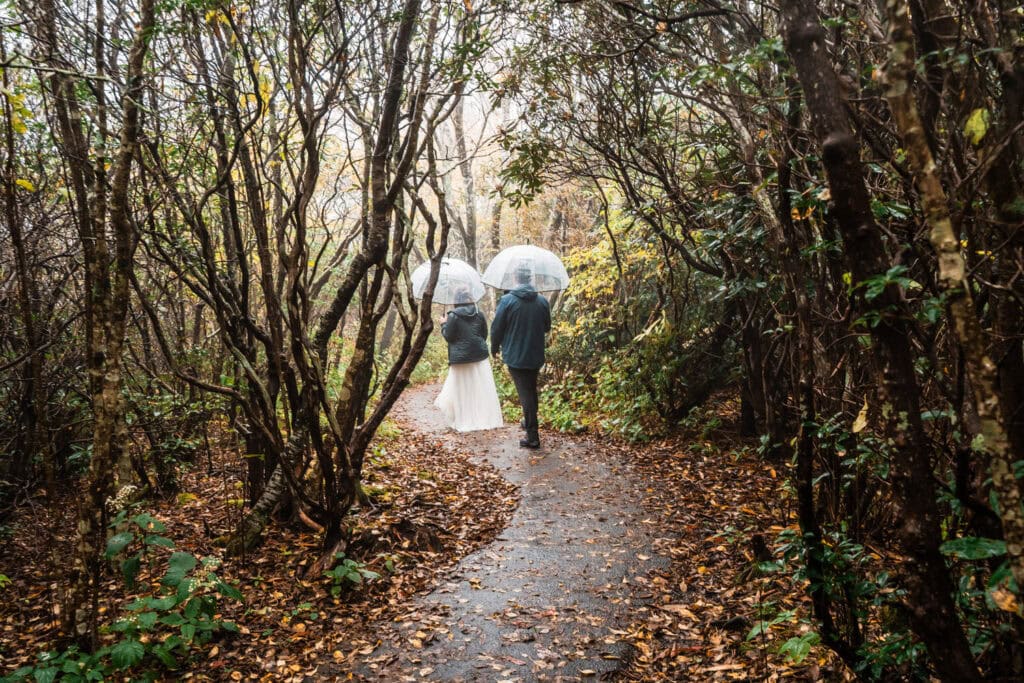
Guest-Inclusive Parkway Wedding
For this kind of experience, we start at a large private Airbnb, inn, or small venue. You’ll probably have a few loved ones alongside as you start your day and get ready for the ceremony.
Your family joins you for a permitted overlook ceremony on the Parkway.
After the ceremony, you’ll take a few group photos, maybe celebrate with champagne (alcohol free on the Parkway per the rules), and return to your Airbnb for an intimate reception together.
Later, the two of you could head back out for sunset portraits at a second mountain location.
This works well because your guests are included without making the public overlook carry the entire day.
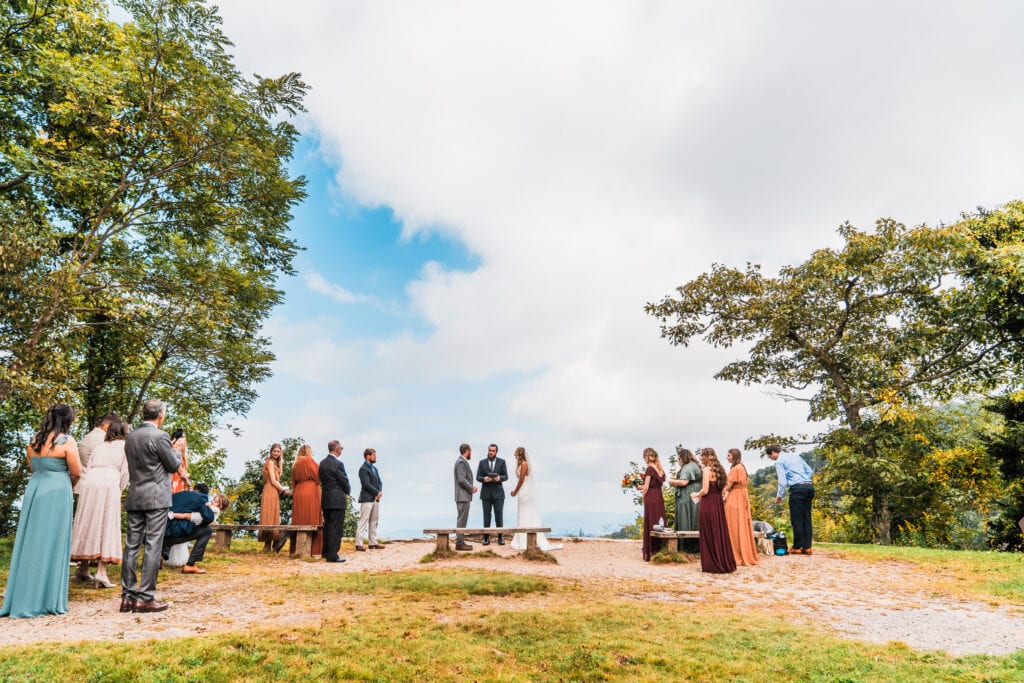
Two-Day Blue Ridge Mountain Experience
This is a variation on the first two experiences. Day one is centered around family, ceremony, dinner, and celebration.
Day two is for the two of you: a sunrise hike, a quiet vow exchange, a waterfall adventure, or portraits somewhere more out in the wild.
This can be a beautiful fit if you want both connection and privacy without trying to cram everything into one day. This is the best of both worlds if want time with loved ones and intentional time together.
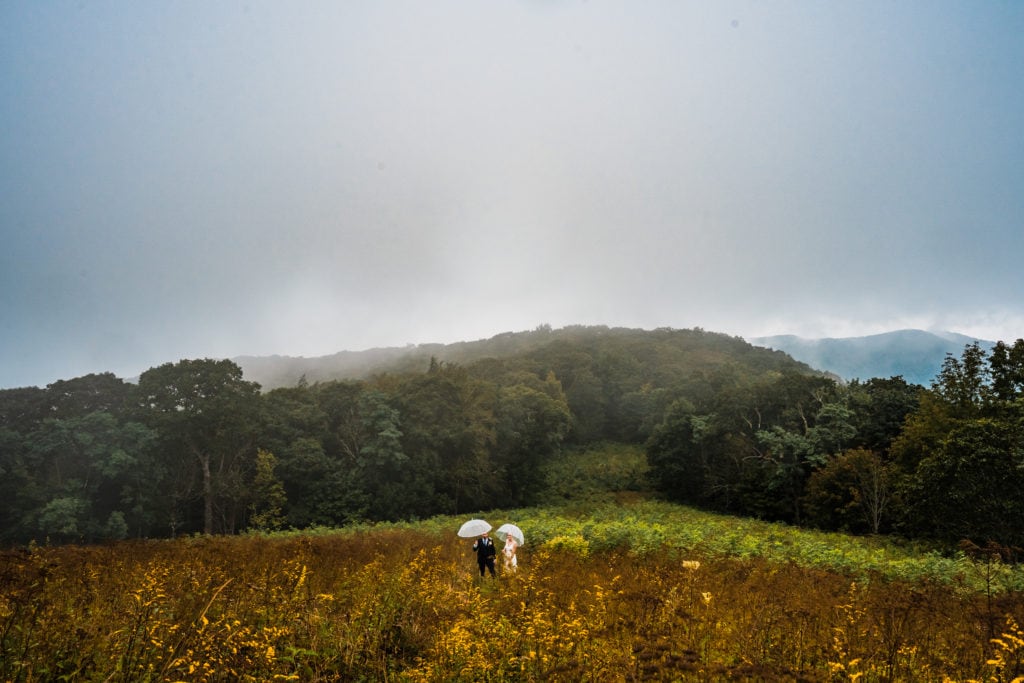
Real Blue Ridge Parkway Wedding and Elopement Inspiration
One of our favorite examples of a Blue Ridge Parkway elopement used two Parkway locations intentionally.
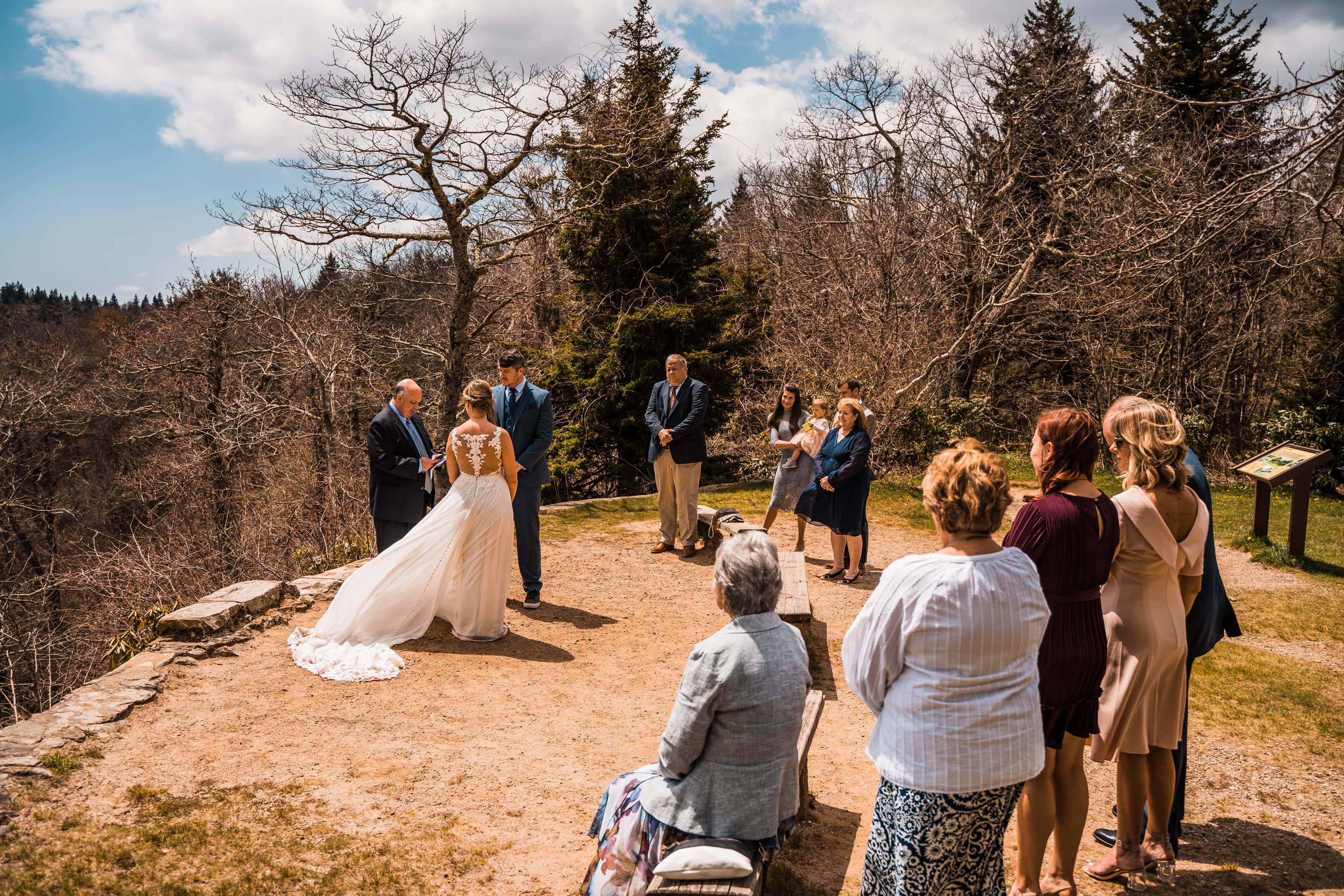
Guests were included for the ceremony at one location, then later we set aside time just for the two of them at another Parkway spot. That kind of structure works well because it recognizes that the best guest location and the best private portrait location are not always the same place.
You can see that real example in our Craggy Gardens elopement story.
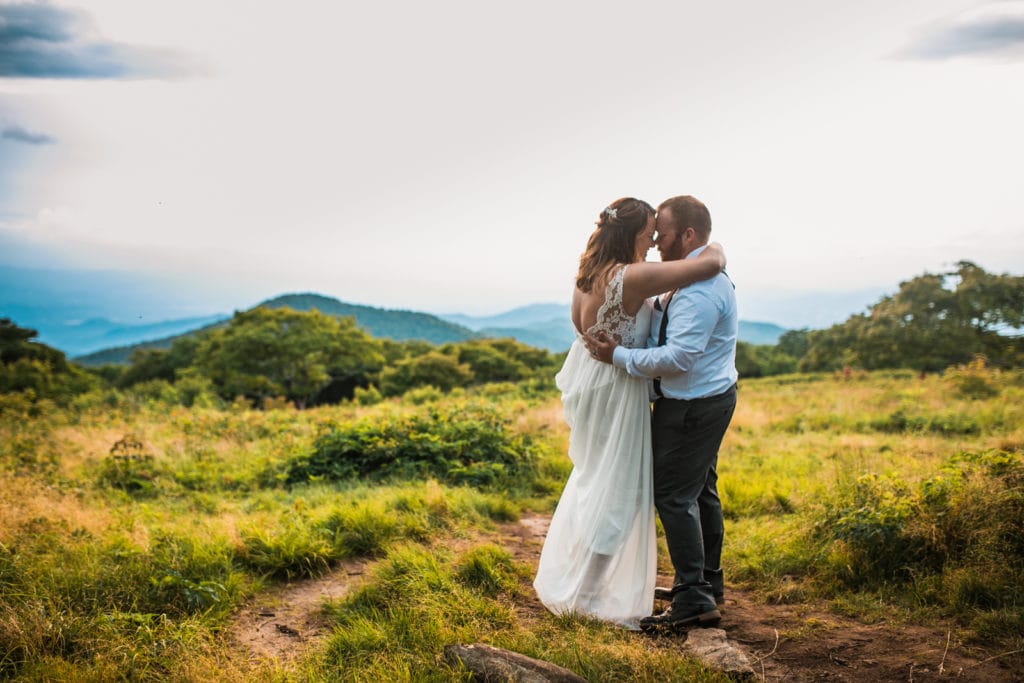
We also have additional guides and stories that may help if you are comparing Parkway-adjacent locations:
- Grandfather Mountain elopement and wedding guide — If you’re drawn to the High Country and Grandfather Mountain area
- Linville Gorge elopement guide — If you want a more rugged, dramatic wilderness near the northern NC Parkway
- Little Switzerland wedding at Switzerland Inn — an example of a nearby venue experience close to the Parkway
- Pisgah National Forest elopement guide — for couples considering high-elevation or forest locations near the Asheville/Pisgah side of the Parkway
- Black Balsam Knob wedding guide — if you’re imagining getting married at one of the most iconic high-elevation landscapes near the Parkway, but outside Parkway jurisdiction
How We Help You Plan a Blue Ridge Parkway Wedding or Elopement
We don’t just hand you a list of overlooks to choose from.
We help you understand how the whole day works based on how you want the experience to feel.
That includes:
- which region of the Parkway fits your vision
- which locations are actually approved for ceremonies
- how permits work
- how guest count changes the plan
- where lodging should be
- what nearby locations may fit better
- how to build a timeline around light, weather, and drive time
- what backup plans are realistic
- how to include family without losing the intimacy
- and how the Parkway can become part of a complete wedding experience
Sometimes the ceremony belongs on the Parkway.
Sometimes the ceremony belongs at a private Airbnb, inn, or venue, and the Parkway becomes the place for portraits, private vows, or sunset.
Both can be beautiful.
The point is not to force your wedding day into one overlook; it’s to design the experience around what actually fits you.
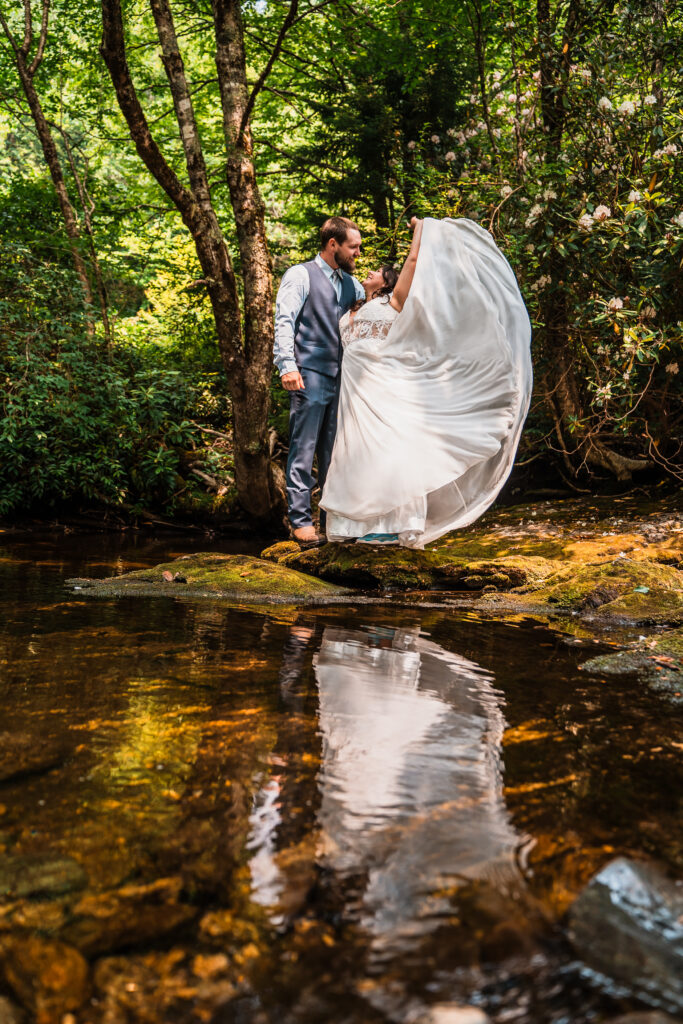
Planning Your Blue Ridge Parkway Wedding or Elopement?
If you are still early in the process, start with our full How to Elope guide. It walks through the bigger planning order before you choose a specific location.
If you are still comparing mountain regions, our Blue Ridge Mountain elopement planning guide can help you think through whether the Parkway, Asheville, Boone, Shenandoah, North Georgia, or another Blue Ridge region is the best fit.
If you are bringing guests, read our guest count and elopement guide before choosing a ceremony location.
And if you are considering a private rental or cabin, start with our Airbnb wedding venue guide or our North Carolina Airbnb wedding venues page.
The Blue Ridge Parkway is beautiful.
But the best wedding days are not built around scenery alone.
They are built around the full experience.